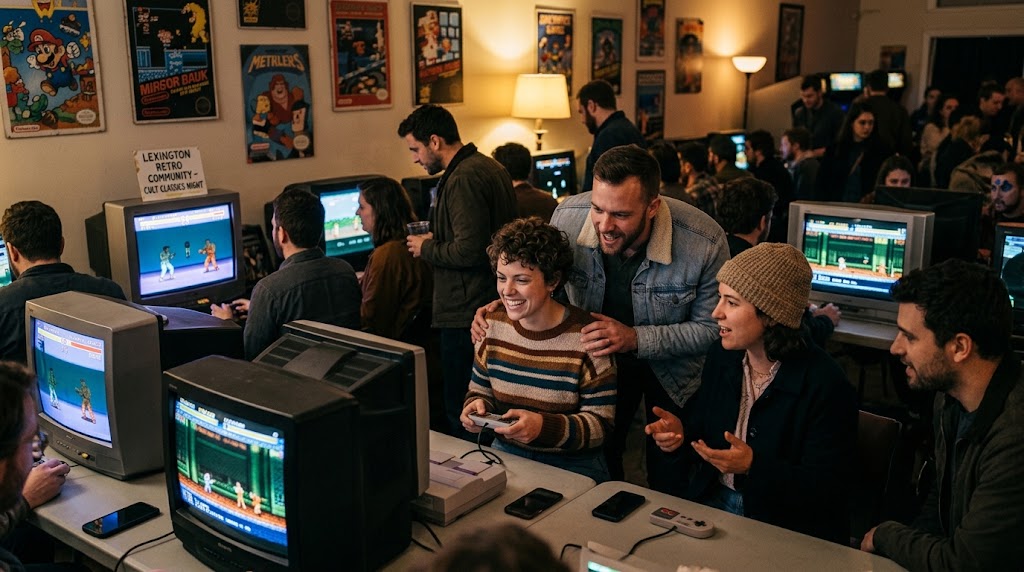
In an industry where multi-billion-dollar publisher budgets are routinely funnelled into hyper-realistic skin textures, real-time ray tracing, and photorealistic environments rendered at 60 frames per second, a curious counter-trend has taken firm hold of global gaming culture.
Every night, hundreds of thousands of players bypass high-end graphics cards and 4K displays to spend hours inside 16-bit dungeons, low-polygon horror corridors, and pixelated strategy grids.
Titles released twenty, thirty, or even forty years ago—from the surreal, suburban melancholy of EarthBound and the intricate strategic depth of Heroes of Might and Magic III to the oppressive, low-resolution atmosphere of the original Silent Hill—are not merely surviving as historical curiosities. They are thriving. Supported by fanatical cult followings, dedicated preservation communities, and a steady influx of younger players who were not even born when these games were first pressed onto cartridges or compact discs, vintage titles are commanding an unprecedented level of cultural authority.
This phenomenon presents a fundamental challenge to the video game industry’s long-standing commercial narrative. For decades, hardware manufacturers and major publishers operated under a simple premise: technological advancement equals superior interactive entertainment. Today, that linear equation is breaking down. The enduring power of retro games with cult followings demonstrates that visual fidelity has hit a point of diminishing returns, proving that art direction, mechanical depth, and emotional resonance ultimately eclipse raw graphical horsepower.
The Photorealism Trap and the Plateau of Visual Fidelity
To understand why players are retreating to the visual simplicity of past eras, one must look at the current state of modern AAA game development.
Over the past two hardware generations, the visual gap between console iterations has narrowed dramatically. The leap from 2D sprites on the Super Nintendo to 3D polygons on the PlayStation in the mid-1990s was revolutionary. By contrast, the difference between modern high-definition rendering and the latest ray-traced lighting effects is incremental—appreciated primarily by tech enthusiasts and digital hardware analysts.
Achieving these incremental visual upgrades has come at a staggering cost:
Production Budget Inflation: Developing a flagship AAA narrative title now routinely costs between $200 million and $400 million, requiring teams of hundreds of artists, animators, and engineers working over five to seven-year cycles.
Creative Conservatism: High financial stakes make large publishers risk-averse. To recoup massive production overheads, studios frequently rely on safe, homogenized game design—filling sprawling open worlds with repetitive tasks, automated quest markers, and aggressive monetization schemes.
The Uncanny Valley: As character models approach photorealism, subtle flaws in facial animation, eye tracking, or movement physics can break player immersion far more aggressively than abstract pixel art ever could.
Moreover, photorealism ages poorly. A game that boasted state-of-the-art realistic graphics in 2005 often looks muddy, awkward, and dated a decade later. Conversely, games built around stylized, constrained art direction—such as Castlevania: Symphony of the Night or Chrono Trigger—possess a timeless aesthetic quality. Their visuals do not rot because they were never trying to mimic physical reality; they were using limited hardware to craft coherent artistic expressions.
The Power of Design Under Constraint
The longevity of cult retro games is rooted in the creative solutions forced by technological limitations. When developers in the 1980s and 1990s were restricted by kilobytes of memory, narrow color palettes, and primitive sound chips, they could not rely on cinematic cutscenes or high-resolution textures to carry a weak experience.
They were forced to master the fundamentals of interactive design: precise controls, clear visual communication, inventive level design, and deeply satisfying gameplay loops.
Consider the original 1994 Super Metroid. Nintendo’s design team had no capability to guide players using high-definition minimaps, voice-acted dialogue, or dynamic objective markers. Instead, they designed the alien environment of Planet Zebes so intuitively that environmental cues, lighting shifts, and subtle door placement taught the player how to navigate the world without a single word of tutorial text. The result is a masterclass in non-linear exploration that feels as crisp and responsive today as it did over thirty years ago.
Similarly, early survival horror classics like Resident Evil and Silent Hill utilized fixed camera angles and foggy, low-draw-distance environments—not purely as artistic choices, but as hardware workarounds to render complex backgrounds on limited processors. Those technical constraints inadvertently created the very dread that defined the genre. The fog in Silent Hill hid rendering boundaries, but it also trapped the player’s imagination in claustrophobic obscurity, proving that what a game leaves to the player’s mind is often far scarier than what high-resolution hardware can display.
In strategy and role-playing games, visual abstraction encouraged deep systems design. Titles like Final Fantasy VI or Fallout 2 relied on text, player agency, and complex stat systems to construct expansive narratives. Because developers could not show every detail on screen, players engaged their own imaginations to fill in the gaps, building a level of personal immersion that modern pre-rendered cinematic sequences struggle to replicate.
The Preservation Underground and Fan-Driven Longevity
The survival of retro games is rarely engineered by the corporate entities that originally owned them. Instead, cult titles endure through the labor of passionate, decentralized fan communities that act as archivists, software engineers, and community managers.
When commercial publishers abandon legacy software—allowing digital storefronts to close, letting copyrights languish, or releasing subpar modern remasters—the preservation underground steps in:
Emulation and Hardware Innovation: Projects like RetroArch, alongside FPGA hardware devices such as the Analogue Pocket, allow players to run legacy code with microsecond accuracy, preserving original games on modern displays without introducing input lag.
ROM Hacking and Fan Translations: Dedicated fan collectives spend years translating region-locked titles into English—such as the famous localization of Nintendo’s Mother 3—or developing total-conversion mods that add new levels, rebalanced mechanics, and expanded storylines to decades-old games.
Competitive Longevity: Games like 2001’s Super Smash Bros. Melee for the Nintendo GameCube maintain thriving international esports scenes entirely through community effort. Players rejected newer, visually superior sequels in favor of Melee’s emergent physics engine, organizing global tournaments and developing custom online matchmaking infrastructure without official corporate backing.
These fan initiatives transform static static commercial products into living software ecosystems. A player picking up Heroes of Might and Magic III in 2026 is not simply playing a 1999 release; they are engaging with an active global community that has spent twenty-five years refining balance patches, creating massive custom maps, and developing open-source engine recreations like VCMI.
The Neo-Retro Explosion: Indie Games and the Visual Shift
The realization that graphics are secondary to mechanics and style has rewired the modern game development economy. Over the past decade, independent studios have leveraged retro visual frameworks to produce some of the most critically acclaimed and commercially successful titles of the modern era.
Rather than competing with multi-hundred-million-dollar studio budgets, indie developers realized that using 8-bit, 16-bit, or low-poly 3D aesthetics allowed small teams to focus entirely on game design, pacing, and emotional depth.
The results have reshaped consumer expectations across the industry:
Stardew Valley: Created by a single developer using classic 16-bit pixel art inspired by Harvest Moon, the farming simulator has sold over 30 million copies globally, outperforming the vast majority of photorealistic AAA releases.
Undertale: Utilizing simplistic, monochrome-adjacent visuals that echo early 8-bit RPGs, the game captured a massive global audience through groundbreaking narrative subversion, unforgettable character writing, and a genre-bending combat system.
Celeste: Combining precise 2D pixel platforming with an intimate narrative about mental health, the game demonstrated that low-resolution art can deliver profound emotional resonance when paired with tight mechanics and responsive controls.
The success of these titles proved that the mass market’s appetite for retro design was not merely driven by middle-aged nostalgia. Millions of younger players with no memory of the 1990s have embraced retro-styled titles because they offer immediate, responsive, and complete gameplay experiences unencumbered by corporate live-service mechanics, intrusive loading screens, or bloated installation files.
The Economic Realities of Modern Gaming
The broader migration toward retro and retro-inspired games also reflects a structural shift in how consumers view value in interactive entertainment.
Modern mainstream game publishing has increasingly embraced the “live-service” business model. Games are designed as persistent platforms optimized for long-term monetization—packed with battle passes, cosmetic microtransactions, always-online requirements, and repetitive seasonal content schedules.
In this environment, returning to a classic retro game offers an experience built on radically different consumer values:
Completeness: A retro game is a finished, self-contained artistic object. When a player purchases or loads a vintage title, they receive the entire game—free from microtransactions, day-one patches, or missing content locked behind future downloadable content (DLC) passes.
Immediate Agency: Legacy games respect the player’s time. Unlike modern titles that drag players through hours of unskippable cinematic intros, forced tutorials, and menu navigation, retro games typically drop the player directly into the core gameplay loop within seconds of powering on the device.
Purity of Ownership: Physical retro media and DRM-free legacy software represent true consumer ownership. In an era where digital storefronts routinely delist modern games or shut down servers, rendering physical discs unplayable, legacy ROMs and cartridges remain permanently functional.
The Permanence of Gameplay
The video game industry is undergoing a quiet philosophical maturation. The naive technological determinism of its early decades—the belief that each increase in polygon count or texture resolution automatically represents progress—has given way to a more sophisticated understanding of interactive art.
Photorealism is a transient technological target; true art direction and mechanical elegance are permanent.
Just as cinema did not render black-and-white film obsolete, and recorded music did not eliminate acoustic instruments, the evolution of graphical processing power has not diminished the fundamental appeal of pixel art, low-poly geometry, or text-driven systems.
Retro games with cult followings endure because they capture the essential spark of the medium: the tactile joy of responsive control, the intrigue of elegant rules, and the power of human imagination working in tandem with creative design. As the modern industry grapples with ballooning budgets and creative fatigue, the ongoing vitality of retro gaming stands as a clear signal from players worldwide: show us something great to play, not just something pretty to look at.
Lost Media Hunts: The Thrill of Finding Lost Internet and Film Treasures
In mid-2008, deep in the subterranean archives of the Museo del Cine in Buenos Aires, archivists made a discovery that sent shockwaves through the global cinematic community. Tucked away in…
Remakes vs. Originals: Why the Classics Are Almost Impossible to Beat
Walking into a modern multiplex often feels like an exercise in cinematic déjà vu. On any given weekend, marquee marquees display titles that dominated box offices twenty, forty, or even…

 Roland