 Roland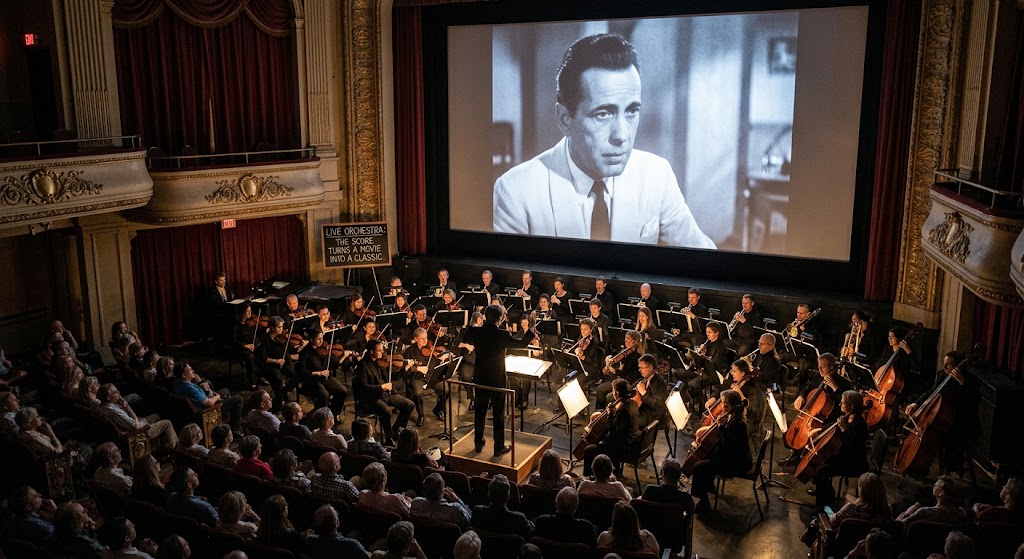
Close your eyes and listen: two low, alternating cello notes—dun-dun, dun-dun—gradually building in tempo and volume. Within two seconds, without seeing a single frame of film, your heart rate spikes, your muscles tense, and an unmistakable image of a phantom predator lurking beneath ocean waves fills your mind.
That is the absolute power of cinematic music.
When John Williams composed those two simple notes for Steven Spielberg’s Jaws in 1975, he did not merely provide background accompaniment for a summer thriller; he solved a catastrophic technical problem. The mechanical shark built for the production famously malfunctioned throughout the shoot, forcing Spielberg to keep the monster off screen for most of the running time. Williams’ score became the shark itself—an invisible, visceral physical presence that turned a troubled B-movie production into a box-office landmark and the first modern blockbuster.
Throughout the history of cinema, the relationship between sight and sound has been the ultimate force multiplier of visual storytelling. While screenwriting, acting, and cinematography construct the narrative frame, it is the musical score that directly accesses the viewer’s nervous system, translating intellectual concepts into raw emotional reality.
From the sweeping orchestral grandeur of Hollywood’s Golden Age to the pulse-pounding electronic synths of modern genre cinema, an unforgettable soundtrack does not simply complement a film—it transforms a good movie into an unassailable classic.
The Architecture of Emotion: How Music Bypasses the Mind
To understand why a soundtrack can elevate a motion picture to legendary status, one must look at how the human brain processes sound.
Vision is an analytical sense. When a viewer watches a scene, their brain actively decodes images, evaluates spatial relationships, parses facial expressions, and analyzes narrative logic. Hearing, by contrast, operates on a primal, evolutionary level. Auditory signals reach the brain’s emotional center—the amygdala—faster than visual information can be processed by the visual cortex.
A film score functions as the emotional translator of the screen:
- Subtextual Guidance: Music tells the audience what a character is feeling when their face remains stoic, or reveals hidden danger in an otherwise peaceful scene.
- Temporal Cohesion: Editing cuts between different camera angles, locations, and time periods can feel jarring. A continuous musical theme stitches disparate visual cuts into a unified, flowing sequence.
- Spatial Scale: A vast desert landscape or an empty sci-fi space station acquires physical weight and immense scale only when paired with music that reflects that spatial expanse.
When a director and a composer achieve perfect synergy, the music does not run parallel to the image; it merges with it, creating a third, unified artistic entity that lodges permanently in collective cultural memory.
The Pioneers of the Motif: The Golden Age and the Leitmotive
The foundational grammar of modern film scoring was established in the 1930s and 1940s by European immigrant composers who brought the rich traditions of late 19th-century opera and symphonic music to Hollywood.
Composers like Max Steiner (King Kong, Gone with the Wind, Casablanca) and Erich Wolfgang Korngold (The Adventures of Robin Hood) pioneered the adaptation of Richard Wagner’s concept of the leitmotif—a specific, recurring musical phrase or melody associated with a particular character, location, emotion, or idea.
Consider Steiner’s work on Michael Curtiz’s Casablanca (1942). Steiner took Herman Hupfeld’s pop song “As Time Goes By” and transformed it into a complex psychological engine. As Rick (Humphrey Bogart) and Ilsa (Ingrid Bergman) navigate love, betrayal, and political sacrifice in war-torn North Africa, the theme mutates continuously: played on a melancholic solo piano to recall lost romance in Paris, arranged as a tense orchestral march to signal geopolitical danger, or swelling into a tragic brass theme during their iconic airport farewell.
The leitmotif allowed music to become an invisible character in the story, operating as a psychological subconscious that spoke directly to the audience.
This orchestral tradition reached its absolute peak in the late 1970s through the legendary collaboration between Steven Spielberg and John Williams. At a time when Hollywood had largely abandoned traditional symphonic scores in favor of 1970s pop tracks and experimental sounds, Williams’ work on Star Wars (1977) single-handedly resurrected the Golden Age orchestral score.
By creating distinct, unassailable leitmotifs for Luke Skywalker, Princess Leia, the Force, and Darth Vader (“The Imperial March”), Williams gave George Lucas’s space fantasy a mythic, timeless weight. Without Williams’ sweeping brass and soaring strings, Star Wars might have been remembered as an eccentric B-movie homage; with it, it became a global cultural mythology.
THE LEITMOTIF EFFECT IN POPULAR CINEMA

Character / Concept: Darth Vader
Composer: John Williams
Musical Structure: "The Imperial March" (Heavy Brass, Minor Key, Rigid March Tempo)
Emotional Impact: Establishes absolute military authority and inevitable dread before the character even speaks.

Character / Concept: The Shark
Composer: John Williams
Musical Structure: Two Alternating Notes (Cello / Double Bass, Crescendo Tempo)
Emotional Impact: Imparts physical presence to an unseen threat, driving instinctual fear.

Character / Concept: The Man with No Name
Composer: Ennio Morricone
Musical Structure: Coyote Howls, Electric Guitar, Whistling, Jew's Harp
Emotional Impact: Re-invents the Western hero as a ruthless, mythic anti-hero.
Re-inventing the Landscape: Morricone, Herrmann, and Subversion
While John Williams perfected the grand symphonic tradition, other legendary composers achieved classic status by systematically shattering score conventions.
In the mid-1960s, Italian composer Ennio Morricone fundamentally redefined the sound of the Western genre through his collaborations with director Sergio Leone on the “Dollars Trilogy” (A Fistful of Dollars, For a Few Dollars More, The Good, the Bad and the Ugly).
Traditional American Westerns relied on lush, Copland-esque orchestral arrangements depicting sweeping prairies. Morricone, working with tiny budgets in Rome, abandoned traditional orchestras entirely. He scored the dusty, violent deserts of Spain and Italy using a bizarre, avant-garde mix of human whistling, screeching electric guitars, acoustic Jew’s harps, church bells, chanting choir vocals, and vocalizations mimicking the howling of coyotes.
Morricone’s scores did not just support Leone’s close-up cinematography; they drove it. The famous three-way standoff at the climax of The Good, the Bad and the Ugly (1966) is an eight-minute masterclass in editing and score synchronization. As Morricone’s “The Ecstasy of Gold” and “Trio” build from quiet trumpet solos into explosive, chaotic crescendos, the music elevates a tense gunfight into an epic, operatic dance of death.
Similarly, Bernard Herrmann’s score for Alfred Hitchcock’s Psycho (1960) proved that severe musical constraint could produce terror.
Faced with a reduced black-and-white budget, Herrmann chose to write a score exclusively for a string orchestra—omitting brass, woodwinds, and percussion entirely. For the iconic shower scene, Herrmann instructed the violin section to play harsh, screeching, non-harmonic notes in their highest register, striking the strings with the wood of their bows. The resulting sound—mimicking the shrieks of birds and the tearing of flesh—became the single most influential horror cue in film history, transforming a low-budget thriller into an unassailable classic of psychological terror.
The Synth Revolution: Electronic Landscapes and Atmospheric Immersion
In the late 1970s and 1980s, the advent of affordable analog synthesizers initiated a new sonic revolution in cinema. Filmmakers realized that electronic textures could convey atmospheric isolation, futuristic anxiety, and surreal dread in ways traditional acoustic instruments could not.
The pioneer of this sonic shift was director and composer John Carpenter. Working with minimal budgets on films like Halloween (1978), Escape from New York (1981), and The Thing (1982), Carpenter composed his own synth scores to save money.
The main theme for Halloween—a simple, relentless 5/4 time signature piano riff layered over pulsing synthesizer basslines—became a masterpiece of minimalist terror. The irregular time signature keeps the listener off-balance, creating a feeling of relentless, unstoppable motion that perfectly mirrors the movement of the film’s antagonist, Michael Myers.
Simultaneously, Greek composer Vangelis achieved cinematic immortality with his score for Ridley Scott’s Blade Runner (1982).
Utilizing the iconic Yamaha CS-80 synthesizer, Vangelis crafted a lush, rain-slicked sonic landscape that fused futuristic electronic pulses with melancholic, noir-inspired saxophone solos. The score did not simply back the visuals of a dystopian Los Angeles; it gave the neon-lit, crumbling metropolis its very soul. Vangelis’s music communicated the existential heartbreak of the film’s synthetic Replicants, elevating a misjudged sci-fi film into a cornerstone of cyberpunk art.
In the 21st century, this electronic tradition was evolved by composers like Trent Reznor and Atticus Ross, whose Oscar-winning score for David Fincher’s The Social Network (2010) replaced traditional cinematic swells with dark, ambient industrial synths. The music exposed the underlying coldness, isolation, and legal warfare behind the creation of social media, turning a dialogue-heavy courtroom drama into a razor-sharp thriller for the modern digital age.
The Modern Orchestral Synthesis: Hans Zimmer and the Sonic Wall
In contemporary cinema, no composer has reshaped the blockbuster soundscape more profoundly than Hans Zimmer.
Pioneering a hybrid style that blends massive brass sections, heavy percussion, and complex electronic sound design, Zimmer shifted Hollywood away from traditional melodic themes toward visceral, texture-driven sonic experiences.
His work on Christopher Nolan’s Inception (2010) exemplifies this modern approach:
- The Slowed-Down Motif: Zimmer took Edith Piaf’s classic song “Non, je ne regrette rien”—used as a plot device in the film to wake characters from dream states—and mathematically slowed down its brass samples to mirror the time-dilation effect of nested dream levels.
- The “BRRRRAAAAMMM” Horn: The resulting massive, low-frequency brass blasts became a global trailer trope, creating a physical sense of architectural scale and impending doom that defined 2010s action cinema.
For Nolan’s Interstellar (2014), Zimmer abandoned action-movie percussion entirely, choosing instead to write the score around a massive, 1926 Harrison & Harrison pipe organ recorded inside London’s Temple Church. The instrument’s massive wind-driven pipes provided a spiritual, breathtaking acoustic scale that matched the infinite vastness of deep space, while its delicate quiet notes captured the fragile love between a father and daughter separated by light-years. The score was not merely background music; it was the emotional anchor that held Nolan’s complex quantum physics narrative together.
The Compiled Soundtrack: When Pop Music Defines Cinema
While original scores dominate film music history, a distinct sub-genre of soundtracks achieves classic status through the masterfully curated compilation of pre-existing pop, rock, and soul music.
In these films, the director acts as a musical curator, using popular records to establish temporal setting, subvert genre expectations, and infuse scenes with instant cultural energy.
Quentin Tarantino is the undisputed master of this technique. In Pulp Fiction (1994), Tarantino famously used zero original orchestral scoring. Instead, he pieced together an eclectic mix of 1960s surf rock (Dick Dale’s “Misirlou”), dusty soul (Al Green’s “Let’s Stay Together”), and obscure rockabilly tracks. By dropping high-energy surf guitar over a violent crime narrative, Tarantino created a cool, hyper-stylish kinetic aesthetic that redefined 1990s independent cinema.
Similarly, Martin Scorsese’s use of rock music—most famously his repeated deployment of The Rolling Stones’ “Gimme Shelter” across Goodfellas (1990), Casino (1995), and The Departed (2006)—creates a frantic, manic energy that mirrors the intoxicating rise and catastrophic fall of his criminal protagonists. The music acts as an adrenaline pump, driving the editing rhythm and immersing the audience directly into the chaotic headspace of his characters.
The Unseverable Bond of Sight and Sound
When we reflect on the greatest moments in cinematic history—Indiana Jones sprinting from a rolling boulder, two star-crossed lovers meeting on the deck of the Titanic, a solitary boxer climbing the steps of the Philadelphia Museum of Art, or a space traveler passing through a wormhole—it is impossible to isolate the visual image from its soundtrack.
Without John Williams, Rocky’s triumph is incomplete without Bill Conti’s soaring trumpet fanfares. Without Ennio Morricone, the Western loses its mythic sting. Without Hans Zimmer, interstellar space loses its awe-inspiring weight.
A great screenplay gives a movie its mind; great acting gives it its voice; brilliant cinematography gives it its eyes. But it is the soundtrack that gives a movie its heart. When the right music meets the right image at the exact right second, the screen fades into history, and a motion picture becomes immortal.