 Roland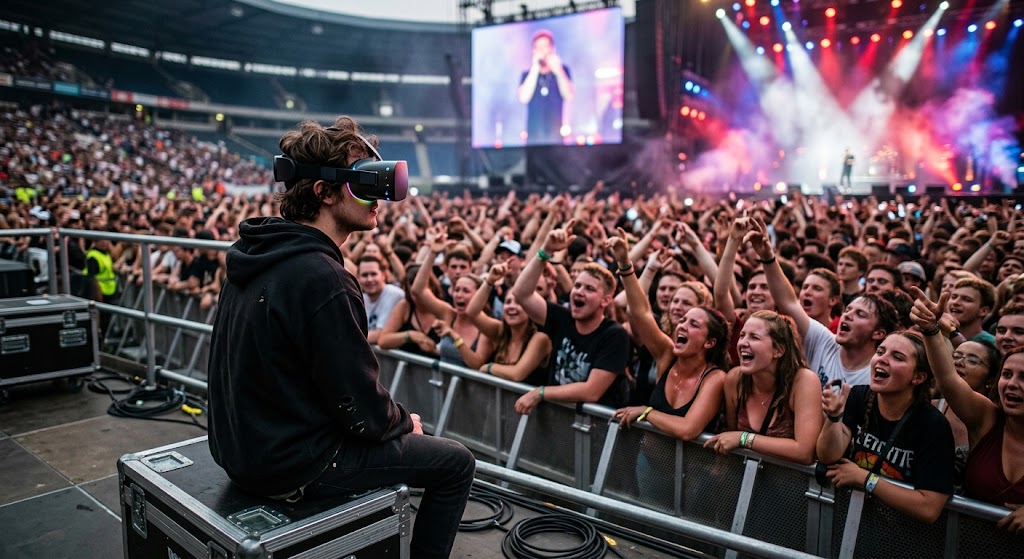
Standing in the middle of a packed stadium during a headlining concert is a sensory assault that defies digital replication. The thunderous sub-bass vibrates through the concrete floor and directly into the listener’s chest; the heat of thousands of bodies radiates through the air; and the collective roar of sixty thousand voices singing a chorus in unison creates a visceral, shared emotional state. For decades, this physical friction—the noise, the crowds, the logistical hassle, and the raw acoustic power—has been the indispensable core of the live music industry.
Yet, a few miles away in a quiet living room, a listener slips on a lightweight virtual reality headset. Instantly, the living room walls vanish, replaced by a hyper-realistic, three-dimensional digital amphitheater. The user is positioned inches from the lead singer on stage, able to glance around at the backing band, customize their personal audio mix, and float above the crowd in high-definition spatial audio. There are no hour-long traffic jams, no $20 beers, no towering spectators blocking the view, and no sold-out ticket queues.
As virtual reality technology, spatial audio processing, and high-speed network infrastructure mature, the global music industry finds itself at a profound crossroads.Tech executives and digital platforms frame VR as the ultimate future of live performance—a boundary-free medium capable of democratizing access, scaling venue capacity to infinity, and offering immersive visual spectacles impossible in physical reality. Conversely, traditional concertgoers, touring veterans, and sociologists argue that virtual environments, no matter how technologically sophisticated, strip away the single element that makes live music meaningful: the unpredictable, contagious energy of a physical crowd.
The debate is no longer speculative. With the market for virtual concert platforms and live-streamed entertainment expanding rapidly, the music ecosystem is forced to confront a fundamental question: Is virtual reality preparing to replace the physical concert, or is it merely constructing a high-tech alternative for an entirely different audience?
The Virtual Promised Land: Engineering the Unlimited Stage
The economic and artistic arguments for virtual reality concerts are formidable. In traditional touring, physical logistics present a hard ceiling on scale and profitability. Transporting hundreds of tons of staging equipment, sound rigs, and lighting grids across oceans requires vast capital investment, extensive carbon footprints, and relentless physical toll on artists and road crews. Furthermore, even the largest stadiums capped by municipal safety codes can host only a fraction of an artist’s global fanbase.
Virtual reality dismantles these physical constraints entirely. When an artist performs inside a virtual or mixed-reality environment, the venue capacity is effectively unlimited. Millions of fans from Tokyo to São Paulo can tune in simultaneously, enjoying identical front-row visibility without leaving their respective time zones.
Traditional Arena Tour: Fixed physical capacity, high freight costs, localized audience.
Virtual VR Broadcast: Infinite digital capacity, zero physical freight, global simultaneous access.
Technological advancements have elevated virtual concerts far beyond the rudimentary 2D live-streams of the early internet era. Modern immersive concert infrastructure relies on a convergence of cutting-edge hardware and software:
- Volumetric Capture and Photorealistic Avatars: Using high-density camera arrays, performers can be rendered in real-time as three-dimensional digital assets, allowing spectators to view their movements from any angle in full depth perception.
- Spatial and Object-Based Audio: Advanced directional audio algorithms dynamically alter the soundscape based on head orientation. If a viewer turns toward the lead guitarist, the instrument’s acoustic profile shifts naturally, mirroring real-world auditory physics.
- Dynamic Environmental Manipulation: Unbound by the laws of gravity or physics, virtual stages can transform mid-song—shifting seamlessly from a photorealistic stadium into an underwater cavern, an outer-space landscape, or an surrealist abstract art piece.
- Customizable Viewpoints:Viewers retain complete agency over their visual perspective, choosing between standing beside the drummer on stage, perching in the soundboard booth, or hovering over the front row.
For independent artists lacking the financial backing for international arena tours, VR platforms offer a direct channel to monetized global audiences. For global megastars, a single virtual event can generate millions of dollars in digital ticket sales, exclusive avatar merchandise drops, and brand sponsorships without the physical exhaustion of a six-month international tour schedule.
The Anatomy of Live Energy: What Code Cannot Replicate
Despite these technological leaps, virtual reality encounters a formidable barrier when attempting to simulate the physical reality of a live concert crowd. Criminologists, psychologists, and musicologists emphasize that the human impulse to attend live performances is not driven solely by the desire to hear music loudly; it is driven by the search for collective effervescence.
Coined by French sociologist Émile Durkheim, “collective effervescence” describes the unique psychological state achieved when a group of human beings gathers in physical proximity to participate in a shared thought or action. In a packed concert venue, this phenomenon manifests in measurable biological and social feedback loops:
- Involuntary Physiological Synchronization: Studies measuring heart rates and respiratory patterns among audience members at physical concerts reveal that crowds naturally synchronize their breathing and heartbeats during high-emotional points of a performance.
- Tactile Acoustic Resonance: Low-frequency sound waves below 100 Hertz are experienced not just through the auditory nerve, but through tactile receptors in the human body. The feeling of bass pressure vibrating through physical tissue is a sensory component that consumer headsets and headphones simply cannot replicate.
- The Spontaneity of Human Interaction: Physical crowds are organic, chaotic ecosystems. The collective tension of waiting for an encore, the shared glance with a stranger during a guitar solo, the physical surge of a mosh pit, or the spontaneous chorus of a crowd carrying a song after the band stops playing are inherently unscripted events.
In a VR environment, user interaction is mediated by software protocols. Even when platforms populate virtual arenas with thousands of customized player avatars, the experience remains fundamentally isolated. An avatar cheering in a virtual lobby cannot make genuine eye contact, bump shoulders, or share an unscripted physical moment with the person beside them.
The spectator remains an isolated observer standing in a room with a plastic device strapped to their face, looking at a digital representation of human presence. The digital proxy can imitate the imagery of a crowd, but it remains incapable of generating the visceral, electric atmosphere of sixty thousand physical bodies sharing air, heat, and emotion.
Comparing the Experiences: Physical Arena vs. Virtual Reality
To evaluate the operational and sensory trade-offs between physical concerts and virtual environments, it is necessary to contrast their core characteristics across key performance indicators.
| Metric / Dimension | Physical Live Concert | Virtual Reality (VR) Concert |
| Audience Capacity | Strictly limited by physical venue size and municipal permits | Unlimited digital scaling across global server networks |
| Sensory Immersiveness | Full tactile, acoustic, somatic, and environmental engagement | High visual and spatial-audio fidelity; zero physical tactile resonance |
| Consumer Access Cost | High (tickets, travel, accommodation, venue concessions) | Low (digital ticket access; eliminates travel and geographic barriers) |
| Crowd Dynamics | Organic, physical collective effervescence; unpredictable energy | Algorithmic, avatar-mediated interactions; controlled environments |
| Production Flexibility | Constrained by stage engineering, safety rules, and physical mechanics | Boundless visual creative freedom; instant environmental shifts |
| Artist Economic Model | High overhead costs (freight, crew, insurance); localized revenue | Low operational friction; high-margin digital ticket and merch sales |
The Infrastructure Friction: Isolation, Comfort, and Hardware Barriers
Beyond the emotional limitations of virtual crowds, the mainstream adoption of VR concerts faces significant practical and hardware challenges.
While consumer virtual and mixed-reality headsets have made major strides in display resolution and ergonomics, prolonged usage during a multi-hour musical event remains physically taxing for many users. Issues such as headset weight, lens fogging, battery limitations, and motion discomfort continue to restrict mainstream consumer willingness to wear hardware for extended periods.
Furthermore, VR is inherently an isolating technology. While a user is immersed in a virtual concert, they are physically cut off from their immediate physical surroundings. They cannot easily converse with non-VR housemates, share a physical drink, or navigate their physical living room safely without breaking the visual immersion.
Physical Concert: Shared social environment + Physical presence + Real-world interaction
VR Concert: Visual immersion + Physical isolation + Mediated digital interaction
This dynamic creates a socio-technical paradox. Virtual reality promises to bring users closer to global events, but it does so by isolating them from their local, physical environment. For a medium like music—which historically served as a social catalyst designed to bring people together in physical spaces—the isolating nature of head-mounted displays represents a significant friction point for casual music consumers.
The Economic Equation: Democratization vs. Premium Experiences
Where virtual reality indisputably excels is in solving the escalating affordability and accessibility crisis of the modern live music industry.
Over the past decade, ticket prices for major concert tours have surged to historical highs. Driven by dynamic pricing algorithms, secondary ticket reselling platforms, high service fees, and escalating venue rental costs, attending a top-tier stadium concert has become a luxury expense out of reach for millions of working-class music fans. For fans residing in rural regions or developing nations, physical access to major international tours is frequently impossible regardless of financial status.
Virtual concert platforms operate as a major economic equalizer:
- Democratizing the Front Row: In a digital venue, every ticket holder can theoretically enjoy optimal sightlines and studio-grade sound quality, removing the strict hierarchy of physical seating tiers.
- Lowering Financial Barriers: Digital concert tickets priced between $15 and $40 allow broader demographic groups to experience live music without incurring travel, childcare, parking, or inflated concession costs.
- Accessibility for Differently Abled Audiences: For individuals with chronic physical disabilities, sensory sensitivities, or mobility restrictions, physical concert venues often present severe architectural and environmental challenges. VR offers a safe, customizable, and controllable environment to enjoy live music without physical stress.
Rather than cannibalizing physical ticket sales, economic data suggests that virtual concert offerings expand the total size of the live music market.They capture revenue from global audiences who would never have purchased a physical stadium ticket in the first place due to geographic, financial, or physical constraints.
The Convergence Horizon: The Rise of the Hybrid Concert Era
As the debate between virtual and physical fans continues, the live entertainment industry is converging on a pragmatic solution: the hybrid concert model.
Major promoters, artists, and media executives are realizing that virtual reality and physical performance do not exist in a zero-sum conflict. Instead, the future of the industry lies in blending the two mediums to create dual-revenue, multi-layered live experiences.
In the hybrid model, an artist performs live in front of tens of thousands of cheering fans in a physical stadium. Simultaneously, arrayed volumetric cameras and spatial audio rigs capture the performance in real time, broadcasting the live event into virtual environments where millions of online users attend digitally.
Physical Venue (In-Person Audience) ──┐
                                      ├─► Unified Global Concert Event
Digital VR Stream (Worldwide Fans)  ──┘
This hybrid architecture yields distinct advantages for all participating stakeholders:
- For Physical Attendees: They experience the raw, unadulterated crowd energy, acoustic resonance, and social atmosphere of a physical venue.
- For Virtual Attendees: They gain real-time, high-definition access to an active, authentic live event—hearing the genuine roar of the physical stadium crowd around them in spatial audio, rather than a simulated digital applause track.
- For Artists and Promoters:They maximize revenue streams by combining traditional physical box office sales with high-volume, global digital ticketing.
Simultaneously, physical venues are increasingly incorporating augmented reality (AR) and mixed-reality elements into the physical concert space itself. Venues like the Sphere in Las Vegas demonstrate how physical crowds can be immersed in high-resolution, dynamic digital environments without forcing individuals to wear personal headsets or disconnect from the surrounding physical crowd.
The Final Verdict: Augmentation, Not Replacement
Virtual reality is not the killer of live music, nor is it a complete replacement for the physical concert.
The belief that digital algorithms, high-resolution screens, and spatial audio could fully substitute for the visceral experience of a live crowd fundamentally misunderstands why human beings gather to listen to music. The sweat, the sub-bass, the physical proximity, the shared vulnerability, and the electric unpredictability of human crowds are not design flaws that need to be engineered out of the experience; they are the entire point of live performance.
However, dismissing virtual reality as a fleeting gimmick is an equally short-sighted error. VR is emerging as the most powerful distribution and accessibility tool the music industry has ever developed. It breaks down spatial and financial barriers, granting millions of fans unprecedented access to front-row experiences that were once reserved for the wealthy and geographically privileged.
The future of music is not a binary choice between a dusty arena floor and a VR headset. It is a broad, interconnected spectrum where both will thrive. The physical stage will remain the sacred, irreplaceable home of live human energy, while the virtual realm will serve as the boundless, inclusive amplifier that carries that energy to the farthest corners of the globe.

 admin
admin