 Roland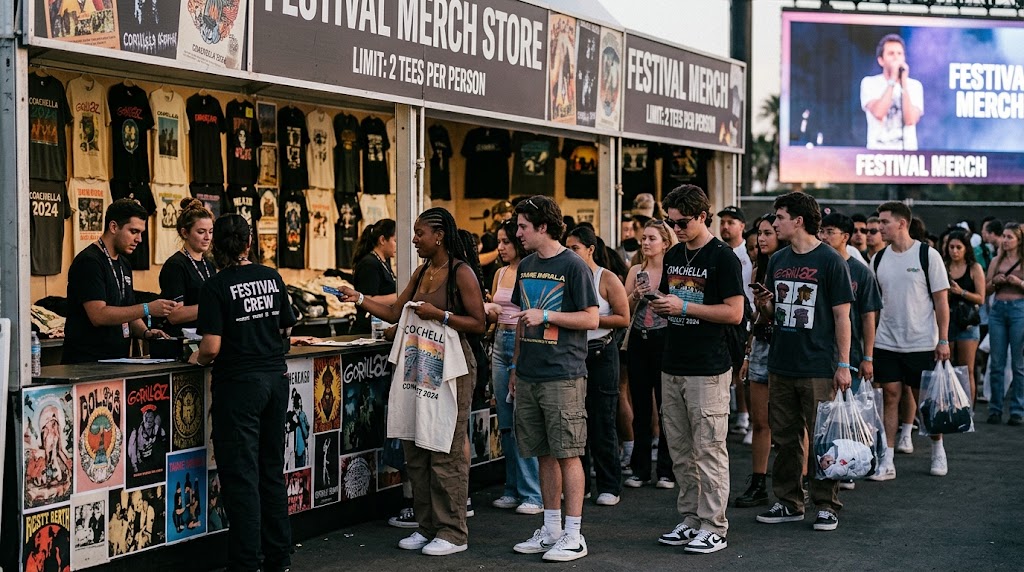
Hours before the first main-stage headliner steps into the spotlight at major music festivals around the globe, the longest queues on the grounds are not at the food trucks or the bar counters. They are snaking around massive, illuminated merchandise tents.
Attendees wait two to three hours in heat and dust, not just for a quick keepsake, but to drop $50 on a heavyweight graphic T-shirt, $120 on a vintage-wash hoodie, or $40 on a date-stamped trucker cap. By late afternoon, popular sizes are exhausted, “Sold Out” stickers cover display boards, and attendees walk away carrying branded canvas totes like trophies from a high-end sample sale.
What was once a peripheral amenity of the live music industry—a basic cotton crewneck featuring a tour itinerary hastily screen-printed on the back—has transformed into the financial engine and cultural vanguard of contemporary fashion. Today, festival merchandise and concert apparel have effectively become the new streetwear.
Driven by the mechanics of scarcity, shifting music economics, and elevated design standards, live event apparel now competes directly with established luxury and urban fashion labels. As traditional retail adapts to a digital-first world, the merch booth has emerged as ground zero for modern youth culture, identity signaling, and high-margin retail strategy.
The Economic Engine: From Peripheral Souvenir to Core Revenue
To understand why festival merchandise has embraced the design aesthetics and pricing structures of boutique streetwear, one must look at the structural transformation of the music industry’s revenue model.
In the era of physical media sales, tour merchandise was largely treated as low-cost promotional collateral. A record label funded a tour to drive CD sales, and t-shirts were sold primarily as casual mementos. However, the streaming economy fundamentally inverted this model. With digital streaming services paying fractions of a cent per play, recorded music now serves primarily as promotional material for live experiences, brand partnerships, and physical merchandise.
Legacy Music Economics: Physical Album Sales → Tour Promotion → Souvenir Merch Sales
Modern Live Economics: Digital Streaming → High-Yield Live Events → Luxury Merch Drops
Industry analytical data estimates the global artist and live event merchandising market at over $6.8 billion, with projections indicating steady growth past $13 billion over the next decade. Live performance apparel accounts for the single largest share of this market. For touring acts and festival operators alike, merchandise sales regularly generate between 15 and 30 percent of total event revenue, frequently delivering higher profit margins than ticket sales or concessions.
Consequently, artists and festival organizers no longer outsource merchandise production to generic promo-wear manufacturers. Instead, they operate dedicated creative departments, partnering with creative directors, high-end garment manufacturers, and specialized merchandising agencies like Universal Music Group’s Bravado or Sony’s Thread Shop. The merch booth is no longer an afterthought; it is an optimized pop-up boutique designed for maximum throughput and high financial yields.
The Design Shift: Boxy Cuts, Heavyweight Cottons, and Bootleg Aesthetics
The elevation of concert apparel from cheap souvenir to prized streetwear is fundamentally a story of garment evolution.
For decades, standard concert tees were manufactured on thin, stiff, low-cost promo blanks that shrank in the wash and featured plastic-heavy prints that cracked over time. The modern festivalgoer, raised on luxury streetwear brands like Supreme, Off-White, and Fear of God, demands an entirely different standard of quality and aesthetic fit.
Today’s high-selling festival apparel relies on specific design and production choices:
- Heavyweight Fabrics: Swapping thin 140 GSM cotton for thick, 240+ GSM ring-spun organic cotton that offers structural drape and durability.
- Modern Silhouettes: Shifting from tight, traditional cuts toward boxy, drop-shoulder, and oversized fits popular in contemporary urban fashion.
- Specialized Washes: Utilizing acid washes, pigment dyes, and vintage distressing to give newly minted shirts the worn-in look and soft feel of 1990s thrift store finds.
- High-Density Graphic Printing: Deploying soft-hand water-based inks, puff prints, and subtle embroidery rather than heavy, rubbery screen prints.
- Bootleg and Heritage Design: Borrowing visual cues from 1970s rock aesthetics, vintage race-car graphics, corporate logo satires, and high-art typography.
This transition was catalyzed by visionary hip-hop and pop artists who bridged the gap between music merchandise and luxury fashion. Early pop-up models pioneered by artists like Kanye West during The Life of Pablo era and Travis Scott with his Astroworld collection demonstrated that fans would line up for blocks to buy music-branded apparel if the design language mirrored high-end streetwear. Today, that blueprint has been adopted across every genre—from indie rock and electronic dance music to regional heavy metal and international pop.
Drop Culture and Scarcity: The Secondary Market Boom
The structural engine driving the speed at which concert tees sell out is identical to the mechanism that powers the sneaker economy: artificially engineered scarcity paired with “drop culture” marketing.
In traditional retail, if an item sells out, the manufacturer orders another production run to capture missed sales. In the modern festival ecosystem, scarcity is a feature, not a bug. Festival organizers and artists intentionally limit production runs of specific items, introducing date-stamped designs, “Day 1 Only” colorways, or location-specific capsule drops.
Limited Production Run → Date/Location Stamp → On-Site Queue Surge → Rapid Out-of-Stock → Secondary Resale Markup
According to retail psychology analysis, limited availability can increase a product’s perceived value by 40 to 60 percent, drastically cutting purchase hesitation at the register. When a fan knows that a specific shirt will never be printed again after a festival weekend concludes, the decision to buy becomes urgent.
This dynamic has created a thriving secondary market. Platforms like Grailed, Depop, StockX, and eBay feature active secondary trading for rare festival apparel. A $50 festival t-shirt from a headlining set or an exclusive festival partnership can command $150 to $400 within hours of a set ending, purchased by collectors and fashion enthusiasts who were unable to attend the event in person.
Social Currency and the “Proof of Attendance” Economy
Beyond material quality and financial scarcity, the dominance of festival merchandise speaks to a deep psychological shift in how younger consumers display identity and social status.
In the physical world, wearing a specific logo has long been a way to signal subcultural alignment. In the digital age, where social media platforms like Instagram, TikTok, and BeReal turn daily life into a broadcasted narrative, concert merchandise serves as high-value visual currency.
Wearing a date-stamped, limited-edition festival tee functions as tangible “proof of attendance.” It communicates three distinct cultural markers:
- Cultural Literacy: Demonstrating refined musical taste and awareness of key cultural moments.
- Experiential Capital: Signaling that the wearer prioritizes live, real-world experiences over static physical goods.
- Exclusivity: Verifying that the owner was physically present at a specific place and time to acquire a piece of history that cannot be bought at a local mall.
Unlike traditional streetwear logos, which simply verify that the wearer had enough money to purchase a brand, a festival tee tells a specific story. It carries memories of shared human energy, specific performances, and personal milestones. In a world dominated by algorithmic digital content, physical items tied to unforgettable real-world experiences hold heightened emotional and social value.
High-Fashion Collaborations and Festival Branding
Recognizing the immense cultural capital generated on festival grounds, legacy luxury houses and established streetwear brands are increasingly bypassing traditional runway shows to launch collaborative capsules directly at music festivals.
High-profile fashion houses regularly partner with major festivals—such as Coachella in California, Primavera Sound in Barcelona, and Glastonbury in the United Kingdom—to design co-branded apparel lines, host VIP pop-up shops, and outfit performing artists.
| Partnership Model | Primary Objective | Target Audience | Example Deliverables |
| Luxury Brand x Festival | Elevate brand coolness; capture youth market | Gen Z / Millennial fashion consumers | High-end technical outerwear, luxury leather accessories, co-branded festival gear |
| Streetwear Label x Artist | Create viral collector items; drive hype | Hypebeast community, collectors | Oversized graphic tees, limited hoodies, skate decks, caps |
| Eco-Label x Event | Promote sustainability; build ethical affinity | Eco-conscious festivalgoers | Organic cotton totes, upcycled vintage blanks, reusable hydration packs |
Furthermore, music festivals themselves have evolved into standalone lifestyle brands. Festivals no longer print basic posters on t-shirts; they design complete seasonal clothing collections featuring custom typography, abstract artwork, and technical outerwear tailored to outdoor environments. Fans wear festival-branded hoodies year-round, treating the festival logo with the same fashion reverence traditionally reserved for major skate or athletic brands.
The Sustainability Crossroads: Drop Culture vs. Eco-Responsibility
The explosive growth of festival merchandise has brought significant environmental scrutiny. The traditional fast-fashion mechanics of event merchandising—producing tens of thousands of cheap, single-use garments shipped globally for a two-day weekend—clashes sharply with the eco-conscious values held by younger festival demographics.
Consumer research indicates that over 65 percent of festivalgoers under 30 actively consider environmental sustainability when making apparel purchases. In response, festival organizers and artist management teams are overhaulling their supply chains to align with modern environmental expectations:
- Sustainable Sourcing: Transitioning to 100% certified organic cotton, recycled polyester blends, and climate-neutral manufacturing facilities.
- Deadstock and Upcycling: Partnering with vintage archivists to screen-print new tour graphics directly over pre-loved, deadstock clothing blanks, ensuring every piece is unique while reducing raw material consumption.
- On-Demand On-Site Printing: Utilizing digital direct-to-garment (DTG) printing setups inside festival merch tents, allowing items to be printed as ordered to eliminate unsold inventory waste.
- Non-Apparel Eco-Merch:Expanding functional, reusable merchandise—such as branded aluminum water bottles, organic canvas totes, and heavy-duty rain ponchos—that replace single-use plastic at events.
By integrating sustainable production practices into limited-edition drops, festival brands increase product longevity while satisfying the ethical demands of their core consumer base.
The Permanent Uniform of Live Culture
The phenomenon of concert tees selling out in minutes is far more than a passing retail trend. It represents a permanent merger of live entertainment, personal identity, and modern fashion commerce.
As traditional retail continues to shift online and digital media becomes increasingly ephemeral, physical objects that anchor human memory, community, and personal style become immensely precious. Festival merchandise has earned its place as the modern generation’s streetwear because it delivers what traditional fashion brands struggle to replicate: authentic cultural moments, shared human connection, and a story printed directly onto every thread.
For the millions of fans who line up outside merchandise tents each weekend, buying a concert tee is no longer about acquiring a souvenir to throw in the back of a closet. It is about acquiring a piece of modern culture—wearing their memories, their musical identity, and their style on their sleeves for the world to see.

 admin
admin