 Roland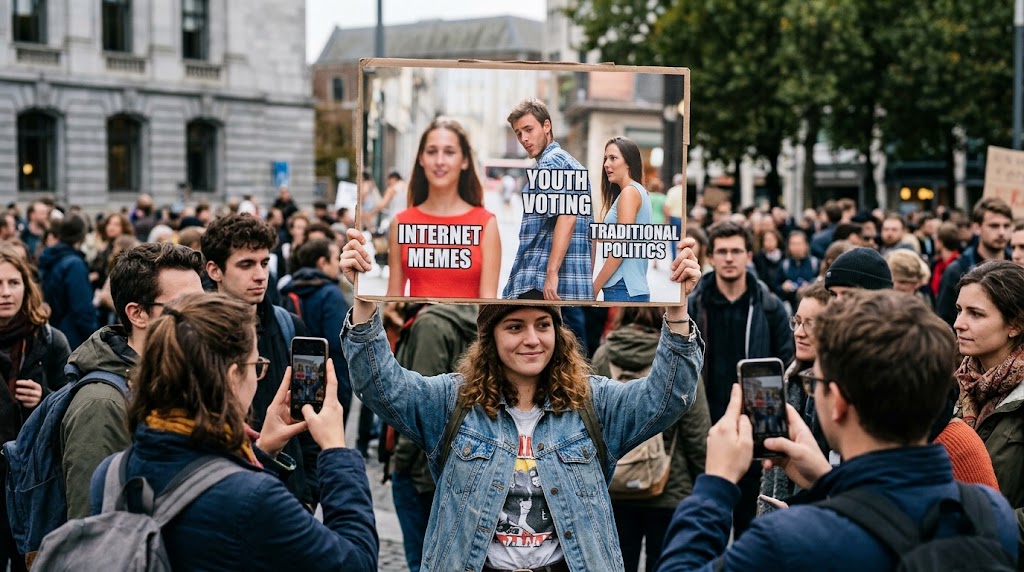
When a crowd of demonstrators took to the streets of Western capitals in recent years, their cardboard signs bore few traditional political slogans. Instead, alongside demands for policy changes were painted cartoon frogs, pixelated cats, and printed screenshots of viral tweets. Thousands of miles away, on the floor of the New York Stock Exchange, institutional investors watched in disbelief as billions of dollars flowed into failing retail companies, driven entirely by an online army of retail traders communicating through rocket emojis and absurd image macros.
These events are not isolated anomalies of digital noise. They are manifestations of a fundamental transformation in human communication.
What began in the early days of the internet as niche jokes shared in obscure message boards has evolved into a dominant, universal dialect of global culture. Memes are no longer merely cute pictures of pets or humorous reaction images; they have become the primary semiotic architecture through which contemporary society processes news, negotiates political identity, drives economic markets, and rewires human language.
In a hyper-connected world characterized by information saturation and dwindling attention spans, internet humor has emerged as the ultimate vehicle for rapid, emotional, and highly compressed human expression.
The Semiotics of the Image-Macro: Modern Hieroglyphs
To understand why memes hold such powerful sway over real-world culture, one must examine how they function as a linguistic system.
In classic linguistics, language relies on agreed-upon symbols—words—to convey complex ideas. However, verbal and written language is inherently slow, bounded by grammar, syntax, and translation barriers. Memes, by contrast, function much like modern hieroglyphs or visual shorthand, compressing dense emotional, social, and political commentary into a single, instantly recognizable visual template.
Consider the ubiquitous image of a cartoon dog sitting at a table inside a burning room, sipping coffee while declaring, “This is fine.” Without a single additional paragraph of context, that image conveys a sophisticated critique of cognitive dissonance, institutional apathy, climate anxiety, and personal helplessness.
By taking an established visual template and modifying its text or overlaying new elements, creators participate in a continuous, open-source cultural dialogue. The meme provides both the premise and the punchline, allowing users to communicate multi-layered commentary in less than a second.
This visual shorthand transcends international borders with unprecedented speed. A meme format originating in South Korea can be adapted by creators in Nigeria, remixed by users in Brazil, and deployed by activists in Poland within hours. The underlying template supplies a shared emotional vocabulary, allowing disparate global communities to participate in a synchronized cultural conversation.
Political Discourse in the Age of Irony
The political sphere has undergone perhaps the most radical restructuring as a consequence of meme culture. Traditional political communication relied on speeches, policy white papers, press releases, and structured television debates—formats that prioritized gravitas, authority, and formal rhetoric. Modern digital discourse, however, thrives on subversion, speed, and hyper-irony.
Memes have democratized political commentary, stripping political leaders of their ability to fully control public narrative. An unscripted gesture, an awkward facial expression, or a verbal slip by a head of state can be clipped, transformed into an image macro, and distributed to millions within minutes, subverting days of carefully crafted public relations messaging.
Furthermore, state actors, campaign strategists, and political movements now actively employ memes as tools of propaganda and persuasion.
- Weaponized Absurdity: Political movements use ironic humor to soften controversial or radical ideas. By wrapping extremist viewpoints or populist rhetoric in layers of irony, advocates can build online communities while maintaining plausible deniability, dismissing critics with a simple response: “It’s just a joke.”
- Public Diplomacy: Sovereign governments and military agencies regularly post memes on official social media accounts to mocking effect during geopolitical disputes, utilizing internet humor as a form of soft-power posturing aimed at international audiences.
- Grassroots Mobilization: Activist groups use humorous templates to break down complex legislative issues into digestible, shareable graphics, mobilizing younger demographics who rarely consume traditional news media.
However, this shift carries significant consequences for civic health. When political debates are conducted primarily through meme formats, nuance is inevitably lost. Complex economic and geopolitical issues are flattened into binary punchlines, encouraging polarization and turning political participation into a form of tribal audience sport.
The Financial Power of Irony: Memes as Market Drivers
The influence of internet humor is no longer confined to social commentary; it has directly breached the mechanics of global finance, establishing what economists now refer to as the “attention economy” or “meme finance.”
The traditional foundation of financial markets relies on fundamental valuation—analyzing corporate earnings, cash flows, asset values, and macroeconomic indicators. Yet, the rise of financial subcultures on platforms like Reddit, Discord, and X (formerly Twitter) demonstrated that collective internet humor can mobilize sufficient capital to move real-world markets, independent of traditional economic metrics.
The phenomenon reached a flashpoint during the “meme stock” surge of 2021, when a loosely organized network of individual investors rallied around struggling legacy companies like GameStop and AMC Theatres. Driven partly by financial ambition, but equally by an ironic desire to inflict losses on institutional short-sellers, these retail traders used absurd memes, viral videos, and coordinated digital sentiment to drive stock valuations to astronomical heights.
Simultaneously, the creation and proliferation of cryptocurrencies named after internet memes—popularly known as “memecoins”—highlighted how financial value can be generated almost entirely out of shared internet culture and social momentum. Assets with zero underlying utility or cash-flow mechanisms achieved multi-billion-dollar market capitalizations simply because they captured the global internet narrative.
In this modern landscape, irony operates as a form of social capital that can be converted directly into monetary value. Market analysts, central bankers, and corporate boards are now forced to monitor social media sentiment algorithms alongside traditional economic indicators, recognizing that a viral meme can alter stock prices faster than a quarterly earnings report.
Linguistic Mutation: How Digital Slang Rewires Everyday Speech
Beyond images and financial markets, meme culture has initiated one of the fastest linguistic evolutions in human history, fundamentally changing spoken and written prose across the globe.
In previous generations, changes in dialect and slang occurred over decades, filtered through regional geography, subcultures, and broadcast television. Today, algorithmically driven content platforms like TikTok, Instagram, and YouTube accelerate the lifespan of slang, pushing new vocabulary from obscure online gaming channels directly into mainstream playground, university, and corporate conversations in a matter of weeks.
Phrases that originated strictly as online shorthand or contextual jokes—such as “brainrot,” “rizz,” “copium,” “main character energy,” and “gaslighting”—have migrated effortlessly into daily face-to-face speech.
This rapid linguistic shift has created a unique sociolinguistic dynamic:
- Accelerated Decay Cycles: Because internet slang spreads so rapidly, its lifecycle has collapsed. A word can move from subcultural cool to mainstream adoption to corporate cringe within months, forcing online communities to constantly invent new linguistic markers to maintain cultural distinction.
- Code-Switching and Generational Divides: Modern speakers increasingly engage in digital code-switching, seamlessly translating visual internet tropes into spoken conversation depending on their audience. This has widened generational communication gaps, as those outside digital echo chambers find themselves unable to decipher conversations laden with internet-derived metaphors.
- Algorithmic Uniformity: Because global audiences consume content powered by similar recommendation engines, regional variations in youth slang are gradually being replaced by a globally standardized internet dialect dominated by English-language digital culture.
The Psychological Engine: Absurdism as Collective Coping
To fully grasp why memes have achieved such cultural dominance, one must look at the psychological landscape of the modern world. Contemporary society is characterized by hyper-connectivity, continuous news cycles, economic precarity, and existential anxieties surrounding global crises.
In this environment, meme culture serves as a primary psychological coping mechanism, operating much like the artistic Dadaist movement of the early 20th century. Following the trauma of World War I, Dadaist artists embraced nonsense, anti-logic, and surrealism to express disillusionment with a world that seemed to have lost its mind.
Modern internet humor follows a strikingly similar trajectory. As global news grows increasingly overwhelming, internet humor leans harder into deep-fried aesthetics, surrealism, and hyper-irony.
When facing overwhelming global events—whether economic recessions, natural disasters, or international conflicts—younger generations systematically flood the internet with dark, absurd jokes. This surreal humor does not signal apathy; rather, it represents a collective attempt to process existential dread in real time. By transforming a frightening, uncontrollable real-world event into a ridiculous, shareable joke, individuals reclaim a sense of agency and shared solidarity.
Laughter, in the context of meme culture, becomes a communal defense mechanism—a way of saying, “This situation is terrifying, but at least we are all witnessing its absurdity together.”
Corporate Co-Optation and the Lifecycle of a Meme
As memes have solidified their position as the primary language of youth culture, corporate marketing departments and public relations firms have scrambled to master the dialect. The days of traditional, earnest advertising are giving way to self-referential, unhinged corporate social media presence.
Major airlines, fast-food chains, and luxury brands now employ young, digitally native community managers tasked with posting self-deprecating humor, engaging in public arguments with other brands, and participating instantly in viral trends. By abandoning formal corporate tones and adopting the voice of an individual internet user, companies attempt to bypass consumer cynicism and build brand loyalty through perceived authenticity.
However, corporate co-optation introduces a structural tension within meme culture known as “the death of cool.”
- Subcultural Origin: A meme is born in an obscure, highly specific online subculture, relying on deep contextual knowledge and insider status.
- Mainstream Proliferation: The format gains traction on public platforms, adapted by broader audiences who dilute its original context.
- Corporate Commodification: Major brands, cable news networks, and traditional media outlets adopt the meme to sell products or report on trends.
- Cultural Extinction: The meme loses its subversive edge, is deemed “cringe” by its original creators, and is abandoned, clearing the way for a new iteration to emerge.
This rapid lifecycle ensures that meme language remains in a perpetual state of revolution, constantly shedding commodified forms to stay ahead of corporate assimilation.
The Future of Human Literacy
The ascension of memes from harmless internet fun to a dominant cultural engine marks a permanent shift in human communication. We have entered an era where visual literacy, emotional compression, and algorithmic resonance are as critical to public engagement as traditional written literacy.
Memes are not a sign of cultural degradation, nor are they a temporary fad destined to fade as technology evolves. They are the organic response of human expression adapting to the architecture of the digital age—a medium designed for a world where information moves at the speed of light, boundaries between physical and digital reality are permanently blurred, and humor remains our most effective tool for navigating complexity.
As artificial intelligence begins to generate synthetic images, videos, and narrative templates at scale, the grammar of memes will only become more intricate. Understanding this modern language is no longer just about getting the joke; it is essential to understanding the politics, markets, and human relationships that shape our physical world.