 Roland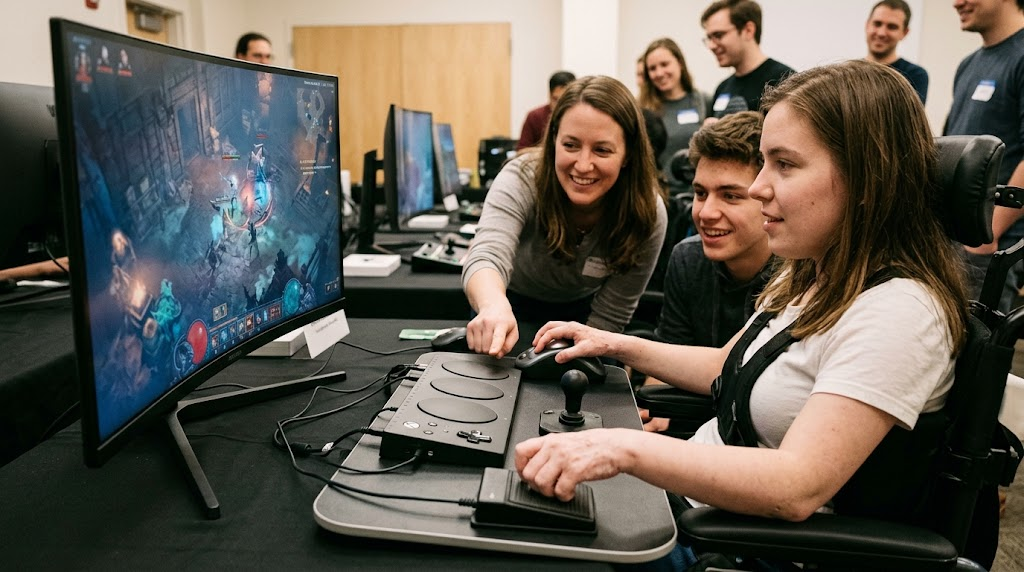
For decades, the fundamental gatekeeper of interactive entertainment was a rigid piece of molded plastic. Held in two hands, packed with dual analog thumbsticks, directional pads, and an array of shoulder triggers and face buttons, the standard game controller demanded a specific baseline of physical dexterity, fine motor control, and sensory acuity. For millions of individuals living with physical disabilities, neurological conditions, or sensory impairments, this hardware design presented an insurmountable wall.
Today, that paradigm is undergoing a historic realignment.
Video games have evolved from a niche pastime into the dominant global medium of twenty-first-century culture. As interactive experiences become primary venues for social connection, artistic expression, and competitive sport, the gaming industry is undergoing a profound movement toward universal accessibility. Driven by pioneering disabled advocates, non-profit organizations, specialized hardware engineers, and forward-thinking software studios, adaptive technology is dismantling traditional barriers to play.
Through modular hardware ecosystems, customizable software suites, advanced biometric sensors, and open-industry collaboration, video games are becoming accessible to populations previously excluded from digital worlds. The shift is redefining not only how games are controlled, but who gets to play them—proving that true accessibility does not compromise artistic vision, but enriches human connection.
The Hardware Revolution: From Rigid Gamepads to Modular Systems
The physical interface between player and game has historically been the most immediate obstacle for gamers with mobility limitations. Conditions such as cerebral palsy, muscular dystrophy, spinal cord injuries, stroke recovery, or amputation often make holding a standard controller—or rapidly pressing multiple triggers simultaneously—physically impossible.
To address this challenge, hardware design has shifted away from a single, static form factor toward fully modular input systems.
Leading this hardware revolution was the launch of the Xbox Adaptive Controller. Designed in close collaboration with advocacy organizations including The AbleGamers Charity, SpecialEffect, and the Cerebral Palsy Foundation, the device acts as a unified hub rather than a fixed gamepad. Featuring two large, low-resistance programmable buttons, the unit contains nineteen 3.5mm input jacks and multiple USB ports. This architecture allows players to plug in external switches, foot pedals, bite switches, single-handed joysticks, and 3D-printed custom toppers tailored precisely to their physical range of motion.
Recognizing the economic and social imperative of inclusive design, major competitors have expanded the adaptive hardware ecosystem:
- Modular Circular Design: Sony’s Access Controller for the PlayStation 5 departed from traditional gamepad geometry entirely, offering a flat, circular pod that can be operated on a tabletop or wheelchair mount without being held. Featuring magnetic, interchangeable button caps and adjustable stick lengths, it allows players to reconfigure physical button layouts to match their dexterity profile.
- Specialized Assistive Peripherals: Devices such as the QuadStick—a mouth-operated controller utilizing sip-and-puff sensor technology alongside a lip-position joystick—enable gamers with quadriplegia to achieve elite-level input precision in complex titles.
- Open-Source Fabrication: The integration of 3D printing networks and open-source CAD files through initiatives like Microsoft’s adaptive accessories library allows occupational therapists and players to manufacture custom thumbstick extensions, palm grips, and mounting brackets at minimal cost.
By decoupling control mechanisms from traditional hand-held gamepads, modular hardware transforms the physical environment. Instead of forcing human bodies to adapt to a standardized controller, the controller is engineered to adapt to the individual human body.
Software as an Equalizer: In-Game Customization and Universal Design
While adaptive hardware provides the physical doorway, software design dictates whether a player can meaningfully navigate the virtual world inside. Over the past several years, video game developers have moved accessibility from a secondary post-launch consideration to a foundational element of core architecture.
Modern AAA games routinely ship with comprehensive accessibility menus containing dozens of granular toggles. These features are designed to address motor, visual, auditory, and cognitive barriers without diluting the core narrative or mechanical experience.
Visual Assistance: High-contrast rendering, screen readers, customizable text scaling, colorblind filters.
Auditory Assistance: Directional closed captions, visual sound cues, mono audio toggle, frequency adjustment.
Motor Assistance: Full button remapping, input toggles, auto-navigation, automated quick-time events (QTEs).
Cognitive Assistance: Simplified control schemes, combat hints, game speed adjustments, objective markers.
Game studios have demonstrated how sophisticated software features can open complex, narrative-driven titles to players with severe disabilities:
1. Visual Accessibility for Low-Vision and Blind Gamers
Pioneering implementations in major titles—such as Naughty Dog’s The Last of Us series and Santa Monica Studio’s God of War Ragnarök—have made it possible for completely blind players to complete complex, three-dimensional action-adventure games independently. Developers achieve this by layering high-contrast visual modes (which render characters, enemies, and interactive items in distinct, vibrant block colors) over intricate text-to-speech screen readers and 3D audio cues. Specific acoustic signals inform players of ledges, pick-up items, incoming enemy attacks, and navigation paths.
2. Auditory Accessibility for Deaf and Hard-of-Hearing Players
Advanced directional closed captioning has replaced basic subtitling. Modern games use color-coded text, speaker identification badges, and screen-edge directional indicators to communicate spoken dialogue, ambient sound effects, and strategic audio cues—such as enemy footsteps or charging weapons—ensuring that hearing-impaired players retain full tactical awareness.
3. Motor and Input Flexibility
Complex control mechanics that once demanded high reflex speed or multi-button coordination are increasingly customizable. Options to convert rapid button-mashing sequences into single button holds, toggle aiming reticles rather than holding down triggers, auto-lock target systems, and automatic navigation aids allow players with limited hand endurance or tremors to enjoy high-pacing combat encounters at their own speed.
Emerging Frontiers: Eye-Tracking, Haptics, and Neural Interfaces
As assistive technology matures, the cutting edge of gaming accessibility is expanding beyond physical switches and traditional software menus into advanced biometric and neural technologies.
Eye-Tracking and Gaze Control
Eye-tracking hardware, pioneered by companies like Tobii, allows players to control camera angles, navigate menus, select targets, and trigger actions using only their eye movement. For gamers with advanced neurodegenerative conditions like Amyotrophic Lateral Sclerosis (ALS), gaze-tracking systems paired with dwell-click software provide a complete, hands-free input alternative that restores access to digital social spaces.
Advanced Haptic Communication
Tactile feedback technology is evolving from basic rumbling effects into a nuanced sensory map. High-definition haptic feedback in modern controllers can translate environmental topography, weather patterns, footstep surfaces, and rhythmic pacing directly into localized hand or body vibrations. For visually impaired or deaf gamers, haptic cues offer a physical channel of spatial awareness that operates alongside auditory and visual data streams.
Brain-Computer Interfaces (BCI)
Looking toward the future, non-invasive Brain-Computer Interfaces represent one of the most promising frontiers in assistive technology. By measuring electroencephalographic (EEG) signals or neural intent, BCI systems allow users to execute digital commands directly through cognitive focus. While consumer-ready BCI controllers remain in early developmental stages, active trials indicate a future where physical mobility limitations no longer dictate a player’s ability to interact with complex digital environments.
The Power of Advocacy, Open Patents, and Legal Frameworks
The rapid acceleration of accessibility in gaming is not an accidental byproduct of technological progress; it is the direct result of organized advocacy, community persistence, and systemic institutional change.
Organizations such as AbleGamers, SpecialEffect, and the International Game Developers Association (IGDA) Accessibility Special Interest Group have spent decades educating studios, funding custom hardware adaptations for individuals, and establishing standardized guidelines—such as the community-authored Game Accessibility Guidelines.
Concurrently, corporate strategies around intellectual property have shifted from proprietary hoarding toward collaborative open-source models:
- Patent Sharing Initiatives: In a landmark move for the industry, major publishers like Electronic Arts (EA) pledged to share key accessibility-related patents freely with competing developers. This initiative grants open access to technologies such as advanced ping communication systems (which allow non-verbal players to communicate complex tactical ideas), colorblind software filters, and personalized sound design tools.
- Government and Regulatory Mandates: Legislative updates worldwide—including enforcement of the Twenty-First Century Communications and Video Accessibility Act (CVAA) in the United States—have established legal standards requiring digital communications, in-game text platforms, and voice chat systems to be accessible to people with sensory disabilities.
This culture of shared knowledge has transformed accessibility from a competitive market advantage into a collective industry responsibility. When one studio develops an innovative control mapping interface or a novel visual aid, those insights are rapidly adopted across the broader development community, establishing elevated baselines for future title releases.
The Economic Reality and the “Curb-Cut Effect”
Beyond the moral imperative of social inclusion, the commercial case for gaming accessibility is formidable.
According to World Health Organization estimates, approximately 15 percent of the global population lives with some form of disability. Industry analytics estimate that there are over 400 million gamers with disabilities worldwide. For game publishers operating in an increasingly competitive, multi-billion-dollar global media market, ignoring this demographic represents a significant oversight in user acquisition and player retention.
Furthermore, investments in accessibility benefit far more than the specific populations for whom they were originally designed—a phenomenon known in urban planning and design as the “Curb-Cut Effect.”
Design Origin: Slope cut into concrete sidewalk curbs to accommodate wheelchair users.
Universal Benefit: Utilized by parents pushing strollers, travelers rolling luggage, delivery workers with hand trucks, and pedestrians with temporary injuries.
In interactive media, features created to assist disabled players frequently enhance the experience for the broader player base:
- Subtitles and Captions: Originally developed for deaf or hard-of-hearing players, subtitles are now utilized by a vast majority of all gamers playing in noisy environments, managing audio levels late at night, or playing in non-native languages.
- Customizable Control Mapping: Designed to accommodate motor impairments, remapping options allow casual gamers, competitive esports athletes, and players using non-standard peripherals to optimize their ergonomics.
- Difficulty and Speed Sliders: Created to lower cognitive and motor barriers, flexible difficulty and game-speed settings enable aging gamers, busy working adults, parents, and casual players to enjoy complex games without experiencing frustration or fatigue.
When developers design for extreme edge cases of human ability, they build cleaner, more robust, and more flexible software that improves the user experience for everyone.
Persistent Challenges: Cost, Standardization, and Platform Barriers
Despite remarkable progress, substantial hurdles remain before universal gaming accessibility is fully realized.
The most acute barrier facing disabled gamers is financial. Specialized adaptive hardware peripherals, custom mounting systems, and mouth-operated controllers often cost hundreds to thousands of dollars. When combined with the high cost of gaming consoles, high-end personal computers, and premium software titles, adaptive setups can remain out of reach for individuals living on fixed disability incomes or facing elevated healthcare expenses.
High Peripheral Costs + Eco-System Fragmentation + Lack of Cross-Platform Hardware Protocol = Access Barriers
Furthermore, system fragmentation presents ongoing compatibility issues:
- Platform Lock-In: Adaptive controllers designed for one console system often require expensive third-party adapters, workarounds, or custom firmware to operate on competing hardware platforms.
- Inconsistent In-Game Implementation: While flagship AAA titles frequently boast massive accessibility suites, smaller independent studios operating on tight budgets often lack the financial resources, engineering personnel, or specialized training required to build deep accessibility options from scratch.
- Competitive Gaming Policies: In the professional esports arena, regulatory bodies frequently struggle to establish fair guidelines regarding adaptive controllers, custom button macros, or software assists, occasionally creating friction between regulatory compliance and athlete inclusion.
Addressing these issues will require continued collaboration between platform owners to establish cross-ecosystem hardware standards, alongside expanded grant funding from charitable networks to make physical peripherals accessible to low-income players.
The Universal Sanctuary of Interactive Play
The evolution of accessibility in gaming marks a monumental shift in how society views digital space. Video games are no longer merely recreational toys; they are virtual landscapes where human beings gather to explore, compete, create, and communicate.
For a person whose physical mobility is restricted in the physical world, an accessible video game offers something profound: an environment of absolute equity. Within a virtual realm, a mouth-operated controller or an eye-tracking system allows a quadriplegic gamer to pilot a spaceship, scale a mountain, or lead a team in competitive play alongside peers without distinction or barrier.
By dismantling the physical, visual, auditory, and cognitive obstacles that once isolated millions of players, adaptive technology is delivering on the ultimate promise of interactive entertainment. It is creating a world where physical variation no longer dictates human participation, proving that when everybody plays, the entire global community wins.


 admin
admin