 Roland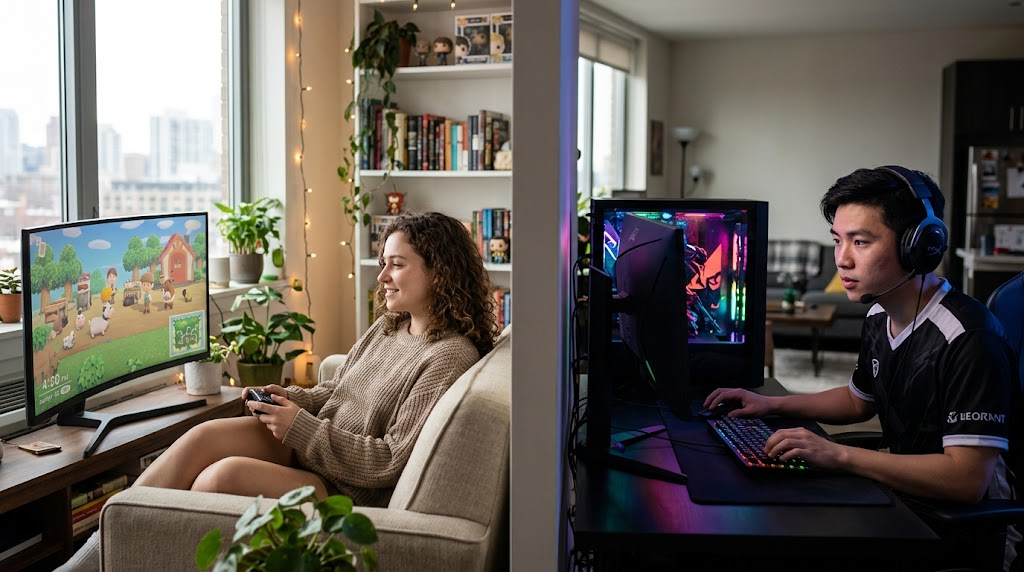
For decades, the video game industry’s financial and cultural epicenter was defined by intensity. Success was measured in high-octane kill-death ratios, punishing twitch reflexes, multi-gigabyte seasonal patches, and grueling rank ladders designed to keep players locked in perpetual competition. From competitive first-person shooters to complex multiplayer online battle arenas, the gaming market rewarded titles that demanded total cognitive immersion and daily operational commitment.
This year, however, a fundamental realignment is sweeping through the global games market.The industry’s fastest-growing segment is no longer populated by hyper-competitive battle royales or punishing action blockbusters, but by what analysts and players collectively term “cozy games”.
Emphasizing low-stress exploration, farming, town-building, gentle crafting, and non-violent narrative progression, cozy titles are capturing millions of active players and commanding an unprecedented share of industry revenue. Market data from major distribution platforms reveals that while flagship live-service competitive titles face widespread player fatigue and stagnating engagement, wholesome, low-pressure games are experiencing exponential growth.
This shift is not merely a transient aesthetic trend; it represents a major structural re-evaluation of how consumers use interactive media in an increasingly demanding world.
The Fatigue of the Endless Grind: Live-Service Exhaustion
The primary catalyst behind the cozy gaming surge is a widespread consumer backlash against the mechanics of modern competitive games. Over the past decade, major publishers shifted heavily toward the live-service business model. Designed to maximize long-term monetization, these games rely on daily log-in rewards, limited-time battle passes, constant balance adjustments, and aggressive rank decay to retain player attention.
What began as dynamic post-launch support has increasingly turned into operational fatigue. Players report feeling as though their evening entertainment has morphed into an unpaid second job. Missing a week of play can mean falling behind the competitive curve, losing access to seasonal cosmetics, or failing to keep pace with a shifting meta.
Furthermore, the social atmosphere of competitive online lobbies has deteriorated. High-stakes ranked modes frequently breed hostility, toxic voice chat, and performance anxiety. For millions of working adults, students, and casual players seeking decompression after long days dominated by real-world deadlines, entering a high-stress competitive environment has lost its appeal.
Cozy games offer the exact antithesis to this pressure model:
- Absence of Timers and Fail States:Players progress at their own pace without penalties for inactivity or suboptimal play.
- Removal of Toxic Competition:Cooperative elements focus on mutual aid, home decoration, and resource sharing rather than direct confrontation.
- Autonomy Over Experience: Players choose whether to spend an hour organizing a virtual garden, fishing along a digital coastline, or decorating a village, free from artificial urgency.
By replacing artificial scarcity and anxiety with comfort and agency, cozy titles provide a restorative psychological environment that traditional hardcore games actively disrupt.
The Economics of Low-Stress Gaming
The cultural rise of cozy gaming is backed by formidable market data. Industry analytics track a massive surge in commercial performance across PC, console, and mobile platforms.
On Steam, the primary distribution platform for PC gaming, market analyses by research firms reveal that the use of “cozy” as a primary descriptor and marketing tag among high-earning titles grew by more than 600 percent over recent years.The tag has outstripped traditional classifications such as “casual” or “wholesome,” evolving into a dominant commercial shorthand for non-violent, player-centric design.
Traditional Hardcore Model: High friction, strict penalties, competitive ranking, live-service urgency.
Cozy Gaming Model: Frictionless progression, low-stress mechanics, creative autonomy, open-ended exploration.
Financial forecasts estimate that the global cozy gaming market is expanding at a double-digit compound annual growth rate, projected to reach several billion dollars over the coming decade. While production budgets for AAA hardcore titles have ballooned into hundreds of millions of dollars—often requiring years of development and carrying immense commercial risk—cozy games are frequently produced by small-to-midsize indie studios.
Titles like Stardew Valley, Palia, Tiny Glade, and Fields of Mistria demonstrate that modest development costs combined with strong artistic direction and satisfying gameplay loops can yield profit margins and player retention rates that rival legacy blockbusters.
Demographic Expansion and Inclusivity
Another key driver of cozy gaming’s dominant popularity is its capacity to pull in a broader, more diverse demographic than traditional hardcore titles.
For decades, the marketing machinery of the games industry focused heavily on a narrow demographic subset: young males seeking power fantasies and physical dominance. Cozy games have systematically dismantled these barriers, attracting a balanced audience across gender spectrums, age brackets, and gaming experience levels.
| Market Attribute | Hardcore / Competitive Titles | Cozy / Life-Sim Titles |
| Primary Motivation | Mastery, competition, ranking, reflex speed | Relaxation, creativity, narrative, mindfulness |
| Demographics | Male-skewed, heavy core youth focus | Broad gender parity, cross-generational appeal |
| Onboarding Barrier | High (steep learning curves, high mechanical demand) | Low (intuitive controls, forgiving mechanics) |
| Monetization Style | Battle passes, competitive cosmetics, loot mechanics | Premium purchase, expansion packs, cozy cosmetics |
| Community Environment | High intensity, risk of toxic voice chat | High cooperation, supportive digital spaces |
The accessible nature of cozy games allows multi-generational play. It is now common for parents to play cooperative farming or exploration titles alongside their children, or for long-distance friends to utilize peaceful virtual spaces as digital cafes for ambient conversation.
Furthermore, the genre’s emphasis on intuitive controls and forgiving mechanics makes it uniquely accessible to non-traditional gamers, expanding the total addressable market for interactive entertainment rather than simply redistributing existing players.
Social Media and the Streaming Vibe Shift
The popularity of cozy games has been further amplified by a structural transformation in digital content creation. For years, live-streaming platforms like Twitch and YouTube Live were dominated by high-intensity esports broadcasts and loud, reactive creators.
Recently, however, streaming audiences have gravitated toward “chill streams” and aesthetic gaming content.Viewers increasingly seek out content creators who foster calm, welcoming streaming environments accompanied by soothing soundtracks, warm visual palettes, and conversational community engagement.
Short-form video platforms such as TikTok and Instagram have also proven instrumental in driving cozy game discoverability. The visual charm of a beautifully decorated virtual cottage, a cleverly organized isometric town, or a soothing sound design clip translates effortlessly into viral, bite-sized videos. This organic, visual word-of-mouth marketing bypasses traditional gaming journalism, driving immediate sales among audiences who may not actively monitor industry news cycles.
Industry Retooling: Major Publishers Take Note
Recognizing that consumer preferences have fundamentally migrated toward comfort and low-stress play, major publishers and AAA studios are attempting to pivot.
Legacy developers known for competitive shooters or complex role-playing franchises are increasingly incorporating cozy sub-systems into their upcoming titles. Open-world action games now regularly feature dedicated housing customization, fishing minigames, farming mechanics, and non-combat social zones designed specifically to capture the cozy audience.
Concurrently, major publishers are acquiring specialized indie studios and launching dedicated publishing labels focused exclusively on wholesome, low-stress experiences. Venture capital investment, which previously chased live-service shooters and blockchain-based competitive projects, is reallocating capital toward cozy management simulators, relaxed narrative adventures, and social sandbox titles.
However, industry analysts warn that traditional AAA publishers may struggle if they attempt to force aggressive live-service monetization into cozy titles. The core appeal of the genre lies in its authenticity, emotional safety, and respect for player time. Attempting to introduce aggressive battle passes, predatory microtransactions, or artificial time-gates into cozy environments risks alienating the very audience seeking refuge from those mechanics.
The Future of Digital Comfort
The rise of cozy games is far more than a temporary pandemic hangover or a fleeting genre boom. It reflects a mature, permanent shift in how human beings interact with digital spaces.
As daily life grows increasingly fast-paced, hyper-connected, and economically stressful, the desire for digital sanctuaries will only intensify. Players are proving with their time and their wallets that the ultimate power fantasy in modern video games is no longer about conquering an arena, defeating opponents, or climbing a leaderboard—it is about finding a quiet, comfortable space to slow down, create, and simply exist.


 admin
admin