 Roland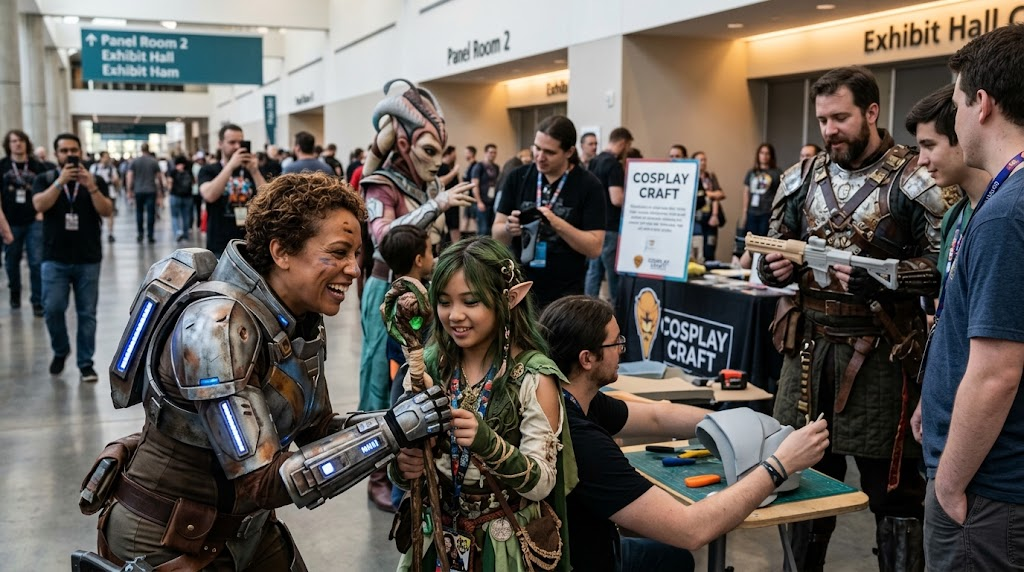
On the floor of a crowded convention center, a figure steps into the sunlight wearing an eight-foot-tall suit of armored mechanical plating. As the character moves, pneumatic joints hiss, micro-LED circuits pulse along the chest piece, and an integrated sound board broadcasts synthesized voice lines that match the movement of the helmet’s visor. Nearby, a crowd of hundreds gathers not merely to admire a fan wearing a costume, but to witness a masterclass in industrial design, performance art, and physical storytelling.
Four decades ago, the term “cosplay”—a portmanteau of “costume” and “play” coined by Japanese writer Nobuyuki Takahashi in 1984—described a niche fan subculture. It was an activity confined largely to dedicated science-fiction and anime conventions, where enthusiasts crafted rudimentary outfits out of cardboard, thrifted fabric, and hot glue to express fondness for their favorite fictional characters.
Today, cosplay has exploded into a multi-billion-dollar global cultural ecosystem. It sits at the vibrant intersection of high-tech manufacturing, digital entrepreneurship, social activism, and contemporary performance art. What was once dismissed by mainstream observers as an eccentric weekend hobby has evolved into a legitimate creative industry and a defining medium of twenty-first-century pop culture.
Cosplay is no longer just about putting on a costume. It has become a sophisticated framework through which millions of people build careers, engineer complex technologies, explore personal identity, and reconstruct community in an increasingly digital world.
From Fan Niche to Corporate Marketing Imperative
The transformation of cosplay from an informal hobby into a professionalized global industry mirrors the broader rise of fan culture within the global entertainment economy. As video games, comic book franchises, and animated series moved from subcultural margins to dominate global box offices and streaming charts, the economic value of active fan engagement skyrocketed.
Entertainment conglomerates, AAA video game publishers, and streaming giants now view cosplayers not merely as enthusiastic consumers, but as vital promotional partners. Major game developers routinely hire prominent cosplayers as official brand ambassadors for international media launches, trade shows like Gamescom and E3, and red-carpet premieres.
Subcultural Origins (1980s-1990s): Homemade garments, local fan gatherings, informal photo swaps.
Digital Expansion (2000s-2010s): Online forums, tutorial sharing, early social media monetization.
Modern Industrial Reality (2020s): Brand sponsorships, high-tech manufacturing, global competition, creator economy integration.
Publishers frequently distribute pre-release character design kits—detailed, high-resolution turnarounds of costume patterns, color palettes, and material textures—directly to the cosplay community months before a game or film is released. By doing so, studios ensure that when a major title launches, high-profile creators are already wearing hyper-accurate, real-world renditions of the characters on social media feeds and convention floors worldwide.
This corporate integration has created a pipeline for professional opportunities. Top-tier cosplayers secure lucrative brand sponsorships, sign with talent agencies, work as professional creature designers for film studios, and travel internationally as paid judges for global craftsmanship competitions.
The Convergence of Advanced Engineering and Craftsmanship
To look at a modern competitive cosplay build is to look at a triumph of self-taught engineering. The technical standards of contemporary cosplay fabrication have rivaled—and in some instances surpassed—traditional Hollywood prop and costume departments.
The modern cosplayer is rarely just a seamstress or tailor; they are a multi-disciplinary maker. A single complex build can require mastery across an array of technical disciplines:
- 3D Modeling and Printing: Creators design custom armor plates and prop components in digital suites like Blender or ZBrush, utilizing industrial resin and FDM printers to manufacture lightweight, precise assets.
- Material Science and Sculpting: High-density EVA foam and thermoplastics like Worbla are heat-molded, carved, and chemically treated to replicate heavy iron, aged leather, or alien chitin.
- Embedded Electronics and Robotics: Microcontrollers such as Arduino or Raspberry Pi are programmed to drive motorized wing spans, motorized helmets, Bluetooth sound systems, and reactive LED illumination arrays.
- Advanced Textiles and Wig Architecture: Historical tailoring techniques are paired with synthetic fiber sculpture, requiring structural internal wiring, custom dyeing, and heat-setting to recreate gravity-defying hair structures.
This relentless drive toward technical innovation has democratized advanced fabrication skills. Online platforms like YouTube, TikTok, and specialized forums host vast, open-source libraries of tutorials where makers freely exchange digital blueprints, chemical safety data, and painting techniques. As a result, teenage hobbyists working out of bedrooms are routinely producing movie-quality prop work using accessible consumer tools.
The Creator Economy and Digital Entrepreneurship
The rise of creator-focused monetization platforms has fundamentally altered the economic reality of the cosplay world. Where cosplayers once absorbed massive personal financial losses to build outfits for a single convention, modern creators can turn their creative process into a sustainable business model.
Platforms such as Patreon, Ko-fi, Etsy, and Twitch have enabled cosplayers to monetize the process of creation rather than just the final product. Audiences no longer tune in solely to see the finished photo shoot; they pay monthly subscriptions to access step-by-step PDF sewing patterns, watch live-streamed prop sanding sessions, receive 3D-printing CAD files, and learn specialized makeup application techniques.
Process Monetization: Digital Patterns → Video Tutorials → Live Streamed Builds → Subscription Access
Product Monetization: Fine Art Prints → Brand Ambassador Deals → Convention Appearances → Custom Prop Commissions
By transitioning from pure performers into educational content creators, professional cosplayers have built resilient digital businesses. A successful creator might generate income simultaneously from digital pattern sales to fellow makers, ad revenue from YouTube tutorials, brand sponsorships from tool manufacturers, and paid appearances at international pop-culture expos.
This shift has elevated the cultural status of the maker. The value is no longer placed exclusively on physical appearance or character resemblance, but on technical skill, pedagogical generosity, and creative transparency.
Identity, Inclusivity, and “Cosplay Is for Everyone”
Beyond its economic and technical dimensions, modern cosplay serves as a powerful arena for personal identity exploration, social empowerment, and cultural discourse.
Historically, fan communities faced criticism for rigid gatekeeping, where individuals were sometimes subjected to harsh scrutiny regarding body shape, skin tone, age, or gender when attempting to portray specific characters. Over the past decade, however, a grassroots cultural movement anchored by the mantra “Cosplay Is for Everyone” has aggressively dismantled these restrictive norms.
Cosplay has evolved into an active form of creative reinterpretation:
- Racebending: Creators colorblind-cast themselves into roles historically depicted as white or East Asian, redesigning garments to incorporate cultural motifs from their own heritages.
- Gender-Bending and Crossplay: Cosplayers intentionally invert, blur, or re-imagine the gender expression of established characters, using the medium as a safe space for gender exploration and LGBTQ+ visibility.
- Adaptive Cosplay: Makers design structural modifications that integrate wheelchairs, mobility aids, and prosthetics seamlessly into elaborate character builds, turning assistive equipment into focal points of artistic design.
By taking ownership of established cultural intellectual property, marginal communities use cosplay to demand visibility within spaces that historically excluded them. Transforming a static, corporate-owned character design into a personalized, real-world performance becomes an act of personal agency and creative reclamation.
Performance Art and the Competitive Stage
While the physical costume provides the visual foundation, the element of “play”—the theatrical performance—remains the heartbeat of the subculture. Cosplay is inherently performative; it requires the creator to study kinetic movement, facial expressions, vocal cadences, and dramatic timing to temporarily bring a fictional persona into physical reality.
This performative aspect culminates on the competitive stage. International tournaments such as the World Cosplay Summit (WCS) in Nagoya, Japan, the Crown Championship of Cosplay, and EuroCosplay operate with the rigor of elite artistic competitions.
| Competition Metric | Judgment Focus | Technical Requirements |
| Craftsmanship Inspection | Internal seamwork, structural integrity, material fidelity, clean finish | Pre-submitted construction portfolios, close-up judge interviews |
| Stage Performance | Dramatic timing, character embodiment, script writing, audio synthesis | Choreographed routines, custom video backgrounds, physical stunts |
| Ingenuity & Innovation | Creative problem-solving, novel material use, dynamic mechanical effects | Live stage reveals, transformational garments, embedded animatronics |
In these arenas, teams of cosplayers present carefully choreographed skits, complete with custom audio tracks, dynamic stage lighting, and synchronized physical stunts. Judges evaluate entries not only on the microscopic precision of inside seam stitching, but on how effectively the performance evokes genuine emotional resonance from an audience.
The Physical “Third Place” in an Isolationist Era
In an era characterized by remote work, screen-mediated social lives, and the steady erosion of traditional physical gathering spots—what sociologists call “third places”—cosplay conventions offer an invaluable physical counterweight.
Events like San Diego Comic-Con, Comiket in Tokyo, and Lucca Comics & Games in Italy draw hundreds of thousands of attendees annually. For many, these gatherings represent rare spaces where non-traditional interests are not merely tolerated, but enthusiastically celebrated.
The collaborative nature of cosplay fosters deep social bonds. The shared experience of “con crunch”—the frantic, late-night push to finish a build before a deadline—creates a sense of solidarity among makers. On convention floors, complete strangers routinely stop to offer emergency repair kits, share specialized crafting advice, or celebrate a shared affection for obscure narrative lore.
This sense of belonging carries tangible mental health benefits. Studies examining fan communities highlight that participating in creative, shared subcultures acts as a protective buffer against loneliness, providing individuals with strong social support networks and a heightened sense of collective efficacy.
Challenges: Burnout, Commercialization, and Online Harassment
Despite its creative vitality, the rapid professionalization and digital expansion of cosplay have introduced complex structural pressures.
The demand for constant content creation driven by social media algorithms has led to widespread creator burnout. Professional and aspiring cosplayers frequently feel pressured to produce increasingly elaborate builds at breakneck speeds to maintain engagement metrics, risking financial strain and physical exhaustion.
Furthermore, the public nature of the internet leaves cosplayers—particularly women, minority creators, and LGBTQ+ individuals—vulnerable to non-consensual photography, harassment, body shaming, and online toxicity. While convention organizations have increasingly instituted strict “Cosplay is Not Consent” policies and upgraded floor security, enforcing safe boundaries across digital platforms remains a continuous struggle.
There is also an ongoing tension between the amateur, community-driven roots of the hobby and its hyper-commercialized present. As high-budget builds dominate social media algorithms, some newcomers report feeling intimidated by the apparent requirement for expensive tools, 3D printers, and professional photography, fearing that the accessible, DIY spirit of early cosplay is being eclipsed by commercial polish.
The Future of Living Art
Cosplay has definitively outgrown its original boundaries. It can no longer be understood simply as fans dressing up in costumes for a weekend convention. It stands as a vibrant, multi-faceted cultural movement that reflects how modern audiences interact with media: actively, creatively, and collaboratively.
In an age dominated by passive digital consumption, cosplayers do something radically active. They take abstract digital pixels, comic panels, and cinematic frames, and through sheer technical skill, physical effort, and emotional investment, translate them into tangible human reality.
As technology continues to advance—with augmented reality, wearable tech, and digital fabrication becoming ever more integrated into the creative process—the line between the fictional world and the physical one will grow increasingly artistic. But regardless of how sophisticated the tools become, the core drive of cosplay remains unchanged: a profound human desire to step outside the self, embody a story larger than life, and connect with a community that shares the exact same dream.

 admin
admin