 Roland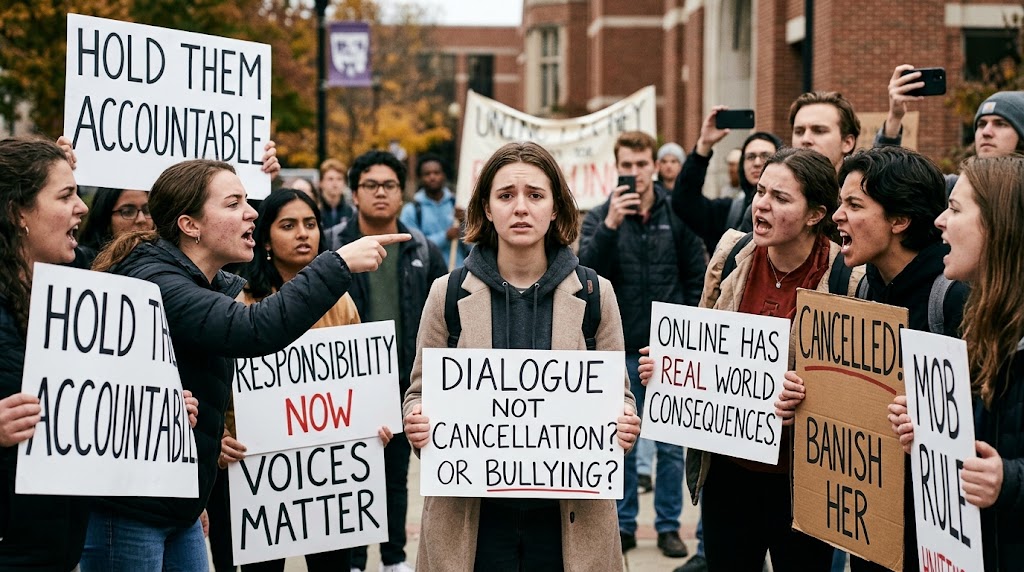
In late 2013, a little-known public relations executive sent a crude, ill-advised tweet to her couple hundred followers before boarding an eleven-hour flight to South Africa. By the time her plane touched down in Johannesburg, her name was the top trending topic on global social media. Thousands of strangers had parsed her personal history, posted her home address, demanded her termination, and gathered at the airport arrival terminal to photograph her face the moment she stepped off the aircraft. She was fired before she reached her hotel room.
That incident remains one of the early, defining cases of modern public shaming. Over the decade that followed, the phenomenon exploded from an occasional viral anomaly into a permanent structural feature of global digital discourse, known colloquially as “cancel culture.”
What began as a democratizing mechanism for ordinary citizens to challenge institutional corruption, systemic discrimination, and abuses of power by high-profile figures has gradually evolved into a complex, volatile social force. Today, public call-outs frequently cross the boundary separating constructive democratic oversight from decentralized digital harassment.
As corporate boardrooms, academic institutions, creative industries, and political parties continuously reckon with viral backlashes, social scientists, legal scholars, and ethicists are examining a fundamental tension of the digital age: How does a society maintain meaningful public accountability without surrendering its public sphere to algorithmic mob rule and psychological cruelty?
The Evolution of the Public Call-Out: From Resistance to Infrastructure
Public shaming is not a creation of the internet; human societies have used ostracization, pillories, and exile as tools of social control for millennia. However, the architectural design of modern social media networks has fundamentally altered the scale, speed, and permanence of the practice.
In its initial phase, the rise of the social media call-out was celebrated by civic activists as a necessary equalizer. Historically, holding powerful individuals—such as politicians, media executives, corporate titans, or celebrities—accountable required access to legacy news outlets, expensive legal teams, or institutional reporting channels that were often gatekept by the very entities being accused.
The democratization of publishing tools changed that dynamic overnight:
- Bypassing Institutional Gatekeepers: Social platforms provided a direct channel for victims of misconduct, workplace harassment, or systemic bias to publish evidence, gather support, and bypass corporate public relations barriers.
- Exposing Hidden Systemic Abuses: High-profile social movements demonstrated that collective public outrage could force institutional investigations and legal accountability where formal channels had repeatedly failed for decades.
- Leveling the Power Asymmetry: Everyday consumers and workers gained the capacity to boycott brands, challenge influential public figures, and demand ethical transparency from global conglomerates through organized digital campaigns.
However, as social media platforms shifted from chronological feeds to algorithmic engagement engines, the mechanics of the call-out underwent a profound structural transformation. The tool originally built to expose institutional misconduct was applied universally—frequently directed at private citizens, low-level employees, students, and creative professionals with negligible societal power.
The Anatomy of Digital Dogpiling: When Criticism Becomes Bullying
The distinction between legitimate public accountability and digital bullying rarely lies in the initial grievance; rather, it manifests in the proportion, velocity, and escalation of the collective reaction.
A legitimate act of public accountability focuses on a specific harm, evaluates evidence in context, seeks proportional remedies—such as an apology, policy change, or resignation—and respects basic human dignity. Digital bullying, by contrast, operates through a process known as “dogpiling,” where thousands or millions of individual users coordinate attacks against a target, detached from the original context or severity of the transgression.
Sociological research into online mob dynamics highlights several key features that push public criticism across the line into harassment:
Algorithmic Amplification of Outrage
Recommendation algorithms are engineered to prioritize content that evokes intense emotional reactions, specifically moral outrage and tribal conflict. Posts that condemn, mock, or call for punishment against an individual generate high interaction rates, prompting the platform to distribute the content to wider audiences. The system rewards participants with immediate social validation in the form of likes, shares, and follower growth, incentivizing increasingly aggressive rhetoric.
Decontextualization and Asymmetric Information
In the rush to participate in a viral movement, complex human interactions are stripped of nuance and reduced to short video clips, cropped screenshots, or isolated quotes. Nuance, intent, and mitigating factors are routinely discarded because they slow the momentum of the viral narrative.
Dehumanization and Mass Scale
When thousands of individuals simultaneously send hostile messages, threats, or insults to a single person, each sender often views their contribution as an insignificant drop in the bucket. To the individual recipient, however, these isolated actions combine into a catastrophic tidal wave of psychological intimidation.
Disproportionate Punishment
While accountability seeks a resolution proportional to the infraction, viral cancellation frequently demands total ruin: immediate job termination, complete social exile, permanent loss of livelihood, and coordinated harassment targeting family members and associates.
When a private citizen makes an error in judgment, an insensitive comment, or an ambiguous remark, and is subsequently met with doxxing—the malicious publishing of private personal data—death threats, and systemic harassment, the interaction ceases to function as a public service. It becomes a form of vigilantism.
The Psychological and Societal Toll: The Architecture of Fear
The consequences of pervasive public shaming extend beyond the immediate targets of viral campaigns, exerting a subtle yet profound chilling effect across broader civil society.
Psychological studies examining victims of public online shaming reveal severe, long-term trauma profiles similar to those experienced by victims of physical stalking and severe domestic abuse. The permanent digital archive of the internet means that an individual’s worst moment, misstatement, or false accusation remains indexed indefinitely by search engines, severely hindering their ability to secure employment, housing, or social relationships years after the event.
Beyond the individual level, the pervasive threat of immediate, non-adjudicated cancellation has altered how institutions and individuals navigate public discourse:
- The Chilling Effect on Intellectual Inquiry: In academic and creative environments, students, researchers, and writers increasingly report engaging in aggressive self-censorship. The fear that an unconventional idea, an exploratory hypothesis, or a challenging artistic work might be selectively clipped and weaponized online deters open debate and intellectual risk-taking.
- The Death of Nuance: Complex social, political, and philosophical questions are increasingly reduced to binary purity tests. Nuanced positions that do not align perfectly with prevailing group orthodoxies are treated as moral failures, discouraging productive compromise and ideological growth.
- The Weaponization of Bad Faith: Cancel culture is increasingly exploited by political bad-faith actors across the ideological spectrum. Operatives deliberately unearth decade-old social media posts or take quotes out of context to neutralize political opponents, turn attention away from policy debates, or settle personal rivalries under the guise of moral righteousness.
The Corporate Reflex: Preemptive Firing and the Illusion of Due Process
One of the primary catalysts converting online outrage into permanent real-world damage is the rapid, risk-averse reaction of modern corporate leadership.
When a social media storm centers on an employee or representative, human resource departments and corporate communications teams face intense pressure to resolve the crisis within hours. In the modern 24-hour digital news cycle, brand safety and risk mitigation frequently take precedence over due process, thorough investigation, or proportional discipline.
This corporate reflex has birthed a predictable crisis-management playbook:
- Viral Ignition: An individual’s real or perceived infraction is posted online and picks up momentum via algorithmic shares.
- Coordinated Targeting: Outraged users tag the individual’s employer, school, or business partners, demanding immediate termination or severing of contractual ties.
- Institutional Panic: Fearing boycotts, negative press coverage, and brand devaluation, leadership issues a swift public statement announcing the individual’s removal or suspension.
- Quiet Decay: The viral mob moves on to a new target, leaving the institution with a fractured internal culture and the individual with little recourse or formal right of appeal.
By caving instantly to online pressure campaigns without conducting internal reviews to establish facts, corporations effectively outsource their internal governance and ethics policies to the loudest voices on the internet. This dynamic incentivizes mob behavior, signaling to online outrage networks that coordinated pressure will reliably yield immediate material destruction.
Accountability versus Retribution: Navigating the Ideological Spectrum
A critical misconception in contemporary political debate is that public shaming belongs exclusively to one political ideology. In reality, the impulse to censor, ostracize, and ruin ideological opponents is distributed across the entire political spectrum.
While left-leaning social movements have frequently utilized public call-outs to target perceived hate speech, systemic bias, and corporate malfeasance, right-leaning networks have deployed identical tactics to target educators, librarians, corporate diversity initiatives, and artists accused of violating traditional values or national loyalty.
The underlying psychological mechanism remains constant regardless of political orientation: moral grandstanding, tribal enforcement, and the pleasure of inflicting punishment on an out-group member under the banner of collective virtue.
The critical distinction that society must draw is not between left and right, but between retributive justice and restorative justice:
| Dimension | Retributive Shaming (Bullying) | Restorative Accountability (Justice) |
| Primary Goal | Humiliation, punishment, and total exile | Education, amends, and systemic reform |
| Focus | Destroying the individual’s character | Addressing the specific harmful action |
| Target Audience | Private citizens, vulnerable individuals, opponents | Powerful figures, institutions, clear abuses |
| Proportionality | Absolute, permanent, and escalatory | Measured, contextual, and time-bound |
| Path to Redemption | Non-existent; apologies are viewed as weakness | Encouraged; genuine growth leads to reintegration |
When public discourse prioritizes retribution over restoration, it deprives individuals of any incentive to learn, apologize, or change their perspectives. If an apology is universally greeted with renewed hostility and viewed as an admission of guilt deserving of further punishment, the target has no rational reason to engage in self-reflection. The inevitable result is heightened defensiveness, radicalization, and deeper social polarization.
Reclaiming the Digital Public Square: Toward Proportionality and Grace
Resolving the crisis of cancel culture does not require abandoning public accountability, nor does it require tolerating genuine harassment, hate speech, or abuses of power. Rather, it demands a collective recalibration of how institutions, tech platforms, and individuals approach digital conflict.
Institutional Resilience and Due Process
Corporations, universities, and organizations must establish robust, transparent protocols for handling public backlashes. Instead of firing individuals within hours of an online flare-up, leadership must institute mandatory “cooling-off” periods during which independent fact-finding can occur. Institutions should distinguish between clear criminal behavior or systemic workplace harassment and minor personal errors, contextual misunderstandings, or protected off-duty expression.
Algorithmic Reform and Platform Responsibility
Social media companies must accept accountability for the design choices that profit from mob behavior. Re-engineering platforms to reduce the viral velocity of outrage—such as introducing friction before sharing contentious content, strengthening anti-doxxing tools, and deprioritizing dogpiling threads—would significantly reduce the weaponization of digital feeds.
Legal Clarification and Protections
Legal frameworks regarding defamation, tortious interference with contractual relations, and digital harassment must evolve to address modern online mobbing. Individuals who organize bad-faith campaigns designed to destroy a private citizen’s livelihood based on fabricated or distorted claims should face clear legal liabilities.
Cultivating Digital Grace and Proportionality
Ultimately, structural and legal changes must be accompanied by a cultural shift in how individuals navigate the internet. A healthy democratic society requires a baseline of intellectual humility—the recognition that human beings are inherently flawed, that contexts vary, and that individuals are capable of growth, education, and redemption over time.
The Path Ahead for Public Discourse
The ability to speak truth to power and challenge entrenched authority remains one of the most vital achievements of the open, digital age. When used responsibly, the collective voice of the public serves as a crucial check on corruption, cruelty, and injustice.
However, when that collective voice is stripped of empathy, context, and proportionality, it transforms from a tool of liberation into an instrument of tyranny.
The challenge facing modern society is not to choose between silent compliance and mob rule, but to build a digital culture mature enough to demand accountability without sacrificing human dignity. Until civil society, corporate leadership, and technology platforms actively cultivate frameworks rooted in due process and restorative grace, the line between justice and bullying will remain dangerously blurred.