 Roland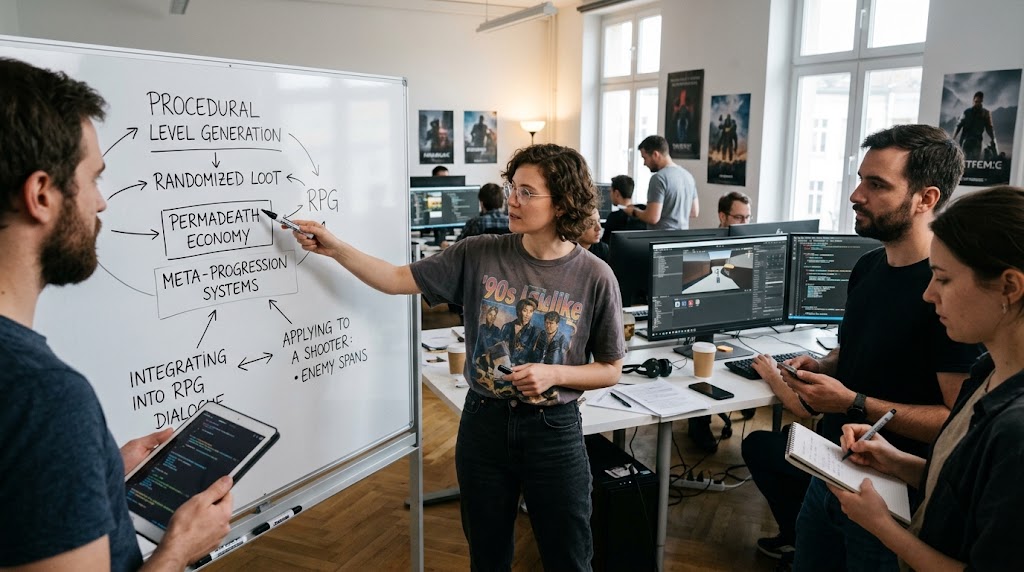
When players stepped into the boots of Kratos in the God of War Ragnarök: Valhalla expansion, or took control of Ellie and Abby in The Last of Us Part II Remastered’s “No Return” mode, they were greeted by a structural framework that felt strikingly unfamiliar for prestigious, narrative-driven PlayStation blockbusters. Upon dying, players were stripped of their immediate upgrades, cast back to a central hub, and prompted to choose from a randomized selection of temporary stat boosts before venturing out for another attempt.
The most expensive, cinematic game franchises in the world had embraced a design philosophy once confined to obscure text-based computer games of the 1980s: the roguelike.
Over the past five years, elements of roguelike design—procedurally generated levels, randomized ability drafts, permadeath, and run-based progression loops—have expanded far beyond their indie origins. What was once a niche subgenre defined by brutal difficulty and permanent loss has quietly evolved into the underlying operating system of modern video game design. From stealth sandboxes like Hitman: World of Assassination and competitive shooters like Splatoon 3 to strategy titles, deckbuilders, and platformers, developers across every tier of the industry are retrofitting their games with the mechanical DNA of the perpetual loop.
This widespread integration is neither accidental nor a passing aesthetic fad. It represents a fundamental response to the shifting economics of video game production, the psychological demands of modern players, and a breakthrough solution to one of interactive storytelling’s oldest paradoxes.
From ASCII Dungeon Crawlers to the Mainstream Consciousness
To understand how roguelike mechanics conquered the mainstream, one must look at how the genre systematically shed its most alienating characteristics while retaining its core psychological appeal.
The term originally derives from Rogue, a 1980 tile-based computer game set in an ASCII-rendered dungeon. Rogue was defined by uncompromising rules codified in 2008 as the “Berlin Interpretation”: grid-based movement, turn-based combat, procedural level generation, complex resource management, and absolute permadeath. If your character died on floor 25, the save file was erased, and you restarted from scratch on floor one with zero carried-over advantages.
For decades, this formula remained a hardcore preserve. The turning point arrived in the late 2000s and early 2010s, when a wave of independent developers began extracting Rogue’s structural engine and grafting it onto entirely different gameplay mechanics. Derek Yu’s Spelunky introduced procedural generation and permadeath to 2D precision platforming; Edmund McMillen’s The Binding of Isaac combined it with top-down dual-stick shooting; and Subset Games’ FTL: Faster Than Light applied it to spaceship management.
More importantly, these developers pioneered the shift from pure “roguelikes” to “roguelites.”
While a traditional roguelike offers no persistent advantages between attempts, a roguelite introduces meta-progression. Dying in a roguelite still resets your immediate run, but it rewards the player with persistent currencies, unlocked item pools, or permanent stat upgrades. Death was no longer a total deletion of effort; it became an incremental transaction.
By softening the penalty of failure while retaining the thrill of high-stakes runs, the roguelite framework expanded its potential audience exponentially. Supergiant Games’ Hades solidified this transformation in 2020, proving that a run-based structure could host compelling character drama, high-production voice acting, and mainstream critical success. By the time Housemarque released Returnal in 2021—a high-budget, third-person sci-fi shooter built around a psychological time-loop—the roguelike had officially entered the AAA lexicon.
The Economic Imperative: The Staggering Cost of Replayability
Behind the creative adoption of roguelike systems lies an undeniable financial reality: the traditional model of AAA game development is facing an unsustainable crisis of scale.
Developing a modern narrative action-adventure game now costs between $200 million and $300 million and requires development cycles spanning five to seven years. A player can consume a hand-crafted 15-hour linear story campaign in a single weekend. In an era where players expect tens or hundreds of hours of value from a $70 purchase—or a monthly subscription service like Xbox Game Pass or PlayStation Plus—developers face immense pressure to generate maximum play time without proportionally increasing production budgets.
This is where roguelike mechanics offer a transformative solution.
By utilizing modular environment tiles, randomized enemy spawns, and dynamic loot pools, developers can create a system capable of producing near-infinite gameplay variations from a finite set of art assets.
Consider IO Interactive’s Hitman: Freelancer mode. Rather than spending tens of millions of dollars building entirely new levels, the studio overlayed a roguelite campaign structure onto its existing sandbox locations. Players are tasked with hunting down randomized targets across existing maps, managing persistent gear inventories, and facing severe penalties for failure. The result transformed a game released years prior into an endlessly replayable stealth-strategy simulator at a fraction of the cost of a full sequel.
Similarly, developer LocalThunk’s Balatro—a poker-based roguelike deckbuilder that became a global gaming phenomenon—demonstrated how systemic randomization and mathematical synergy can hold a player’s attention for hundreds of hours using minimal graphical overhead. The game’s genius lies entirely in its mechanical loop, proving that procedural tension and build craft can eclipse expensive cinematic set pieces in driving engagement.
In an industry struggling with widespread layoffs, studio closures, and escalating budgets, the roguelite framework provides developers with a structurally efficient mechanism to deliver deep replayability without driving production teams to financial exhaustion.
The Psychology of the Synergy Draft: “Just One More Run”
At the heart of every roguelike mechanic is a finely tuned psychological feedback loop built around variable reward schedules—the same behavioral mechanism that makes slot machines and card games deeply engaging.
In a traditional action game, a player’s power increases linearly along a fixed curve designed by the developers. In a roguelite, power growth is non-linear, unpredictable, and highly customisable during every individual session.
During a single “run,” a player is continually presented with randomized choices:
- Do you select an upgrade that increases critical hit damage, or one that releases a poison cloud whenever you dodge?
- Do you sacrifice maximum health for a high-risk, high-reward attack bonus?
When these randomized variables align, they produce what game designers call “synergy”—moments where distinct mechanics stack upon one another to create broken, overwhelmingly powerful character builds.
This mechanic fundamentally changes the player’s relationship with agency and mastery. Victory does not simply feel like the result of following a developer’s pre-scripted path; it feels like a personal discovery, an improvised masterpiece forged out of chaos.
Even when a run ends in failure, the brain attributes the loss not to insurmountable skill barriers, but to poor luck or suboptimal choices. The immediate thought upon returning to the menu is rarely frustration; it is the conviction that the next draft will deliver the perfect combination of abilities. This psychological momentum fuels the ubiquitous “just one more run” syndrome.
Furthermore, this modular structure aligns cleanly with modern consumption habits. A complete run in games like Dead Cells, Risk of Rain 2, or Slay the Spire typically lasts between 30 and 60 minutes. It provides a self-contained narrative arc—a beginning, a rise to power, a climax, and a conclusion—that fits neatly into the busy schedules of older gamers while providing streamable, highly varied content for younger audiences on Twitch and YouTube.
Narrative Integration: Solving Death in Video Games
For decades, story-focused video games operated under an awkward narrative compromise regarding player mortality. If a protagonist died in a cutscene, it was permanent; if they died taking a bullet during gameplay, the screen simply faded to black, loaded a checkpoint, and asked the player to pretend the failure never happened. Ludonarrative dissonance was accepted as an inevitable price of admission.
Roguelike mechanics offered writers an unexpected breakthrough: what if dying was not a break in the narrative continuity, but the catalyst for it?
Hades revolutionized this approach by turning death into the primary driver of character interaction. Returning to the Underworld’s central hub after a failed escape attempt was not a reset button; it was the only way to advance dialogue trees, deepen relationships with gods and mythological figures, and unlock new narrative context. The protagonist, Zagreus, was canonically immortal, making every defeat a logical step in his ongoing attempt to flee his father’s realm.
Other genres quickly adapted this philosophy:
- Psychological Sci-Fi (Returnal): Space scout Selene crashes on an alien world where time resets upon her death, forcing her to confront her unraveling mind and past traumas across shifting landscapes.
- Immersive Action (Deathloop): Colt is trapped in a 1960s-inspired island time loop, using every failed attempt to gather intelligence, map rival assassin schedules, and execute the perfect multi-target hit in a single run.
- Character Atonement (God of War Ragnarök: Valhalla): Kratos willingly enters a shifting realm of memory and illusion, using the recurring loop to confront physical manifestations of his past atrocities in ancient Greece.
By embedding permadeath directly into the narrative lore, writers have converted game-over screens from immersion-breaking errors into meaningful story beats. Players no longer view death as wasted time; it becomes an essential chapter in their character’s evolving journey.
The Risk of Homogenization and Roguelike Fatigue
Despite the structural benefits, the rapid ubiquity of roguelike mechanics has sparked growing debate among critics and game designers regarding the long-term impact on game diversity.
The primary concern is the potential erosion of bespoke, hand-crafted level design. While procedural generation can construct millions of spatial variations, it struggles to replicate the pacing, dramatic tension, and intentional environmental storytelling of a meticulously hand-designed stage. Games relying heavily on procedural algorithms run the risk of feeling atmospheric yet emotionally hollow—a collection of interchangeable corridors and combat arenas devoid of memorable identity.
There is also the danger of mechanical mismatch. When applied thoughtfully, roguelite mechanics elevate a game’s core loops. However, when publishers force run-based progression onto genres that thrive on steady, linear immersion, the result can feel artificial—a lazy alternative to designing meaningful endgame content or expansive campaign levels.
When every game demands that players master randomized upgrade trees, manage inventory loss, and repeat early levels dozens of times, the distinct identity of individual genres begins to blur into a single, homogenized design template.
The Permanent Rewiring of Interactive Design
The pervasive spread of roguelike mechanics is not a temporary trend destined to vanish when the next design craze arrives. It represents a permanent expansion of how interactive media manages challenge, longevity, and player agency.
Much like how role-playing game (RPG) elements—such as experience points, skill trees, and gear leveling—gradually migrated out of tabletop adaptations to become baseline features of action games, sports simulators, and shooters, roguelike loops have become a foundational building block of modern digital entertainment.
By bridging the gap between high-budget cinematic presentation and high-efficiency systemic design, the roguelike framework has provided an industry at a crossroads with a path forward. It turns failure into progress, randomness into strategy, and limited assets into endless possibilities. As gaming continues to balance the staggering costs of production against the infinite appetite of its global audience, the eternal loop remains the most powerful tool in the developer’s arsenal.

 admin
admin