
 Roland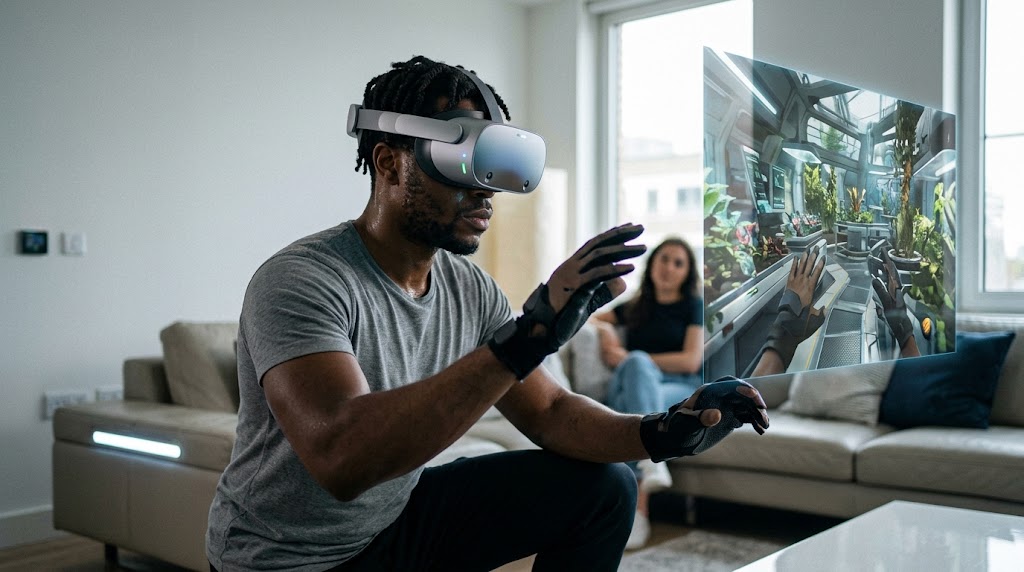
A decade ago, the promise of virtual reality gaming was defined by compromised ambition. Early consumer headsets were tethered to expensive desktop computers by thick bundles of copper cables. Displays suffered from the distracting “screen-door effect,” where dark grid lines separated individual pixels. Tracking sensors frequently lost sight of hand controllers, and prolonged play sessions routinely ended in bouts of nausea.
In 2026, that era of mechanical friction feels distinctly distant.
Today, a user slipping on a modern headset encounters an experience that feels less like looking at a screen and more like stepping through a physical portal. Dual micro-OLED panels render imagery at resolutions approaching 4K per eye.Eye-tracking sensors continuously measure pupil movement to render hyper-realistic detail exactly where the eye is focused. Wireless networks transmit high-fidelity environments without perceptible latency, and spatial audio engines accurately model how sound bounces off virtual concrete, wood, and metal.
With the global virtual reality gaming market expanding beyond $33 billion in 2026, the technology has evolved from a niche novelty into a mature computing platform. Yet as hardware engineering achieves milestones once thought decades away, the industry faces a fundamental question: Has VR gaming finally achieved its ultimate goal of total immersion, or do physical, economic, and creative barriers continue to keep the holodeck dream just out of reach?
The Optical Breakthrough: Erasing the Screen-Door Effect
For the first eight years of consumer VR, the primary obstacle to visual presence was optical resolution. Even high-end displays lacked the pixel density required to fool the human eye at close range, creating a persistent sensation that the user was peering through a fine wire mesh.
The widespread integration of micro-OLED technology and pancake optics has effectively eliminated that artifact. By packing millions of microscopic organic light-emitting diodes onto silicon backplanes, display manufacturers have pushed density levels beyond 3,000 pixels per inch.
This optical shift has created a clear bifurcation in the 2026 hardware market:
- Ultra-Premium Spatial Computers:Devices like the Apple Vision Pro and Samsung’s Galaxy XR lead the upper tier of display performance. Featuring resolutions near 3,500 by 3,800 pixels per eye, these devices deliver around 34 to 40 pixels per degree. Text reading, long-distance spotting in flight simulators, and fine mechanical tasks in virtual environments are now as sharp as on a physical 4K monitor.
- Mass-Market Standalone Headsets:At the mainstream consumer tier, devices such as the Meta Quest 3 and Quest 3S offer a balance between performance and affordability. Utilizing advanced pancake lens stacks and efficient Qualcomm Snapdragon processors, these untethered headsets deliver crisp visuals and full-color passthrough for under $500, serving as the primary volume drivers for the global VR software economy.
- Specialized PC and Console VR:Platforms like Sony’s PlayStation VR2 and high-end enthusiast headsets like the Bigscreen Beyond 2 and Pimax Crystal Super cater to core gamers seeking maximum graphical fidelity. By pairing dedicated GPUs with high-dynamic-range (HDR) OLED panels, these systems render dark scenes and lighting effects with physical accuracy.
The visual breakthrough has been further accelerated by dynamic foveated rendering. By utilizing integrated infrared cameras to track the exact orientation of the user’s retina, game engines allocate maximum rendering power exclusively to the central fraction of the field of view. The peripheral vision is rendered at lower resolutions without the user ever noticing, enabling mobile hardware to produce lighting, shadow, and geometry effects that previously required power-hungry desktop computers.
The Sensory Shift: Haptics, Spatial Audio, and Neural Feedback
Visual clarity alone does not create total presence. True immersion requires convincing the body’s entire sensory nervous system that a virtual space possesses tangible physical properties.
In 2026, audio engineering has advanced from simple stereo pan to complex wave-field simulation. Modern spatial audio plugins model human pinna acoustics—how the external structure of the physical ear filters sound waves—in real time. When a virtual object drops behind a player, the audio engine calculates reflection paths off virtual walls, atmospheric absorption, and phase shifts, allowing players to pinpoint sound origins within centimeters purely by instinct.
Simultaneously, touch feedback has evolved far beyond basic rumble motors. Modern controllers use voice-coil actuators and localized haptic arrays capable of simulating distinct textures—the subtle difference between running a hand across rough stone versus polished metal, or the distinct mechanical click of a firearm mechanism.
Beyond controllers, the consumer haptics industry is experiencing accelerated growth:
- Haptic Vests and Accessories: Wearable haptic vests equipped with dozens of independently controlled transducer points allow players to feel the impact of incoming projectiles, spatial rain, or the deep rumble of proximity explosions across their torso.
- Resistive Trigger Systems: Console and PC VR systems employ adaptive force feedback in hand triggers, simulating the physical resistance of pulling a mechanical bowstring, squeezing a vehicle brake, or handling delicate virtual glass.
- Micro-Pneumatic Haptic Gloves: While high-end force-feedback gloves remain largely in industrial and military training markets, consumer-tier peripheral makers are beginning to introduce lightweight fabric gloves equipped with micro-pneumatic bladders that physically restrict finger movement when grasping virtual objects.
Emerging research is also addressing the biological divide between visual motion and physical sensation. Hardware developers are experimenting with subtle, non-invasive galvanic vestibular stimulation (GVS) and targeted ultrasonic pulses. By sending harmless electrical or acoustic micro-currents to the inner ear’s balance organs, these systems can gently match the body’s sense of balance with the movement occurring on screen, significantly dampening motion sickness for susceptible players.
The AI Effect: Populating Virtual Worlds with Living Logic
While hardware provides the sensory envelope, the rise of advanced generative artificial intelligence has fundamentally altered how virtual worlds interact with the player.
In previous generations of VR gaming, immersion frequently collapsed during non-combat interactions. Non-player characters (NPCs) were rigid, repeating canned dialogue trees and ignoring physical cues from the player. A player could wave their hands inches from an NPC’s face or drop a virtual bottle at their feet without eliciting a natural reaction.
In 2026, AI-driven behavioral models have made virtual populations dynamically responsive:
- Contextual Gaze and Gesture Recognition: Integrated computer vision models allow NPCs to track a player’s body language, eye contact, and physical gestures. An NPC will react with irritation if a player stands too close, show surprise if a player brandishes a weapon unexpectedly, or mirror subtle head tilts during conversation.
- Unscripted Natural Dialogue: Large language models optimized for low-latency voice synthesis allow players to speak naturally into their headset microphone. Characters respond in real time, in character, with zero noticeable pause, integrating world lore, past player decisions, and immediate environmental changes into their conversation.
- Procedural World Adaptation:AI algorithms actively analyze player behavior to alter environmental conditions, enemy tactics, and puzzle mechanics on the fly, ensuring that virtual environments remain unpredictable and organic.
This convergence of generative AI and spatial computing has transformed storytelling. Rather than feeling like a visitor executing pre-programmed game triggers, the player operates as an active participant in an environment that observes, remembers, and reacts to their presence.
The AAA Dilemma: Software Bottlenecks and Platform Ecosystems
Despite these extraordinary technological strides, the VR industry continues to grapple with a persistent structural challenge: the software development bottleneck.
Building a modern, full-scale AAA video game requires production budgets ranging from $100 million to over $300 million. For traditional game publishers, recovering those costs requires a massive install base of tens of millions of active consoles or high-end PCs.
While the total active VR user base on platforms like SteamVR and Meta Horizon has grown steadily—with SteamVR regularly recording over 4 million monthly active users—the overall market size remains a fraction of the traditional console and mobile ecosystems. Consequently, many top-tier gaming studios remain cautious about funding massive, ground-up VR exclusives.
Instead, the 2026 VR content ecosystem relies on three distinct pillars:
- Platform-Funded System Sellers:Platform holders, particularly Meta and Sony, continue to finance high-budget narrative titles internally to drive hardware sales. Franchises adapted specifically for spatial play—such as Batman: Arkham Shadow, Metro Awakening, and Alien: Rogue Incursion—demonstrate that full-length, cinematic story campaigns are entirely viable in VR.
- Hybrid Flat-to-VR Conversions: Game engines like Unreal Engine 5 and Unity now feature streamlined spatial tools, allowing developers to build traditional console games while simultaneously deploying native VR modes. This approach significantly lowers financial risk, allowing players to experience major releases like racing simulators, survival games, and first-person shooters either on a flat monitor or inside a headset.
- Independent and Social Phenomenons: Mid-tier indie developers continue to generate the highest engagement and revenue returns in VR. Over 100 VR games have generated more than $1 million in revenue on standalone store fronts, with games focused on physics-based combat, social deduction, rhythm mechanics, and multiplayer sandboxes dominating overall play time.
The software ecosystem has proven sustainable and profitable for specialized developers, but the scarcity of continuous, blockbuster AAA releases remains the primary reason many traditional gamers have yet to adopt VR as their primary gaming platform.
Ergonomics and Human Biology: The Remaining Friction
Even the most photorealistic virtual world cannot overcome a fundamental human constraint: physical discomfort.
While modern headsets have shedding significant weight compared to early prototypes, wearing a 400-to-500-gram box strap-mounted to the human face still creates mechanical fatigue during extended sessions. Facial pressure, thermal buildup, strap tension, and neck strain remain real physical limits to session length.
Furthermore, hardware engineers are working to solve the Vergence-Accommodation Conflict (VAC)—a neurological disconnect that remains a primary cause of visual fatigue in stereo displays:
- The Mechanism: In the physical world, when human eyes look at an object, two things happen simultaneously: the eyes rotate inward toward each other (vergence), and the physical lenses inside the eyes reshape to focus light on the retina (accommodation). Both distance cues match perfectly.
- The VR Conflict: In standard VR headsets, the displays sit at a fixed focal distance (typically 1.5 to 2 meters). While a player’s eyes rotate to converge on a virtual object that appears inches away, the physical lens inside the eye must remain focused on the screen 2 meters away.
- The Solution: Next-generation research prototypes are integrating varifocal display systems—optics that use liquid crystal lenses or mechanical actuators guided by eye-tracking to physically adjust the focal plane in real time, matching natural eye accommodation and eliminating visual strain entirely.
Until varifocal displays and ultra-lightweight form factors (under 200 grams) become standard consumer features, physical comfort will continue to restrict average VR gaming sessions to shorter intervals compared to traditional screen gaming.
Market Bifurcation and the Economic Road Ahead
As the industry progresses through 2026, virtual reality gaming is no longer a monolithic category. It has split into distinct market segments serving different economic tiers and user expectations.
| Market Segment | Target Price Range | Representative Hardware | Primary Use Case | Key Strength |
| Mass-Market Standalone | $300 – $500 | Meta Quest 3S, Meta Quest 3 | Casual gaming, fitness, social VR | Low barrier to entry, wireless freedom |
| Console & Mid-Tier PC | $500 – $1,000 | Sony PSVR2, Pico 4 Ultra | Core gaming, high-end narrative titles | High graphical power, HDR displays |
| Enthusiast Simulator PC | $1,000 – $2,000 | Pimax Crystal Super, Bigscreen Beyond 2 | Flight, racing, and space simulators | Extreme resolution, ultra-lightweight form |
| Spatial Computing | $3,000 – $3,500+ | Apple Vision Pro, Samsung Galaxy XR | Productivity, media, high-end spatial play | Unmatched optics, natural hand-eye control |
This economic segmentation highlights the current state of consumer adoption. Mass-market standalone hardware drives the user volume necessary to keep developers profitable, while ultra-premium devices push the technological boundaries that will eventually trickle down to affordable hardware in future hardware generations.
Simultaneously, the industry is witnessing a significant expansion into mixed reality (MR). Modern headsets are no longer purely isolating, blindfolded experiences; high-resolution, low-latency color passthrough allows games to project virtual entities directly into the user’s physical living room. Alien creatures burst through real drywall, tabletop strategy games unfold across actual dining tables, and fitness routines turn physical furniture into interactive obstacles. This blend of physical and digital reality offers a bridge for users who feel uncomfortable with total isolation.
The Horizon of Virtual Presence
To answer whether VR gaming in 2026 has reached its full potential: Immersion as a technological capability has undeniably achieved its breakthrough threshold.
The primary sensory hurdles that plagued early hardware—screen-door effects, severe motion sickness, unnatural audio, and inaccurate tracking—have been systematically solved by brilliant optical, acoustic, and computational engineering. When a player puts on a top-tier headset today, the sensation of existing inside a virtual space is no longer a clumsy illusion; it is a convincing physical reality.
However, reaching full potential as a dominant cultural medium requires more than technological elegance. It requires a continuous, self-sustaining ecosystem of software that justifies daily engagement, paired with hardware form factors so light and natural that slipping them on feels as effortless as putting on a pair of eyeglasses.
The physical portal has been constructed, and the digital foundations are firmly in place. The task remaining for the industry over the next decade is no longer proving that virtual reality can work, but making it an indispensable part of everyday play.

 admin
admin