 Roland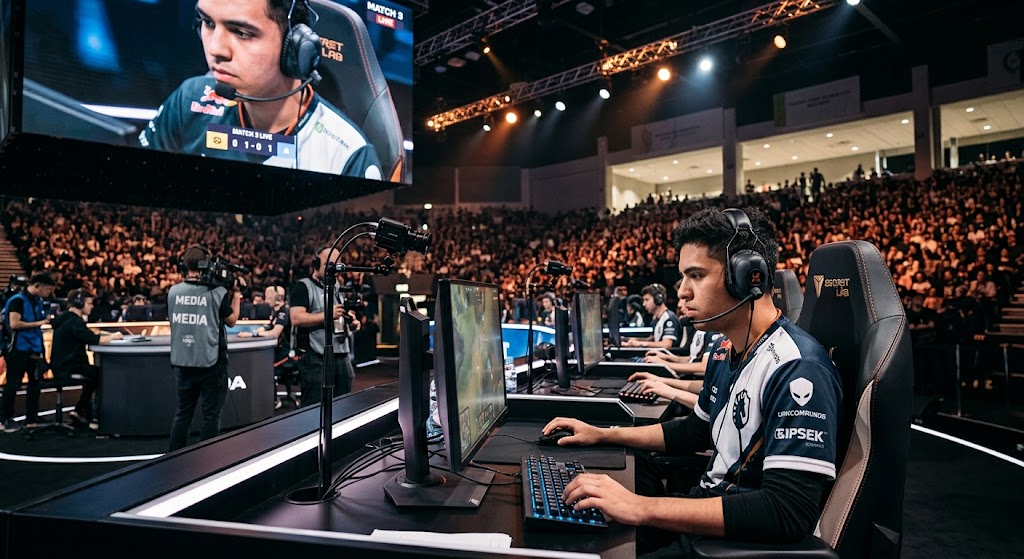
Inside a state-of-the-art training facility in Seoul, South Korea, five young men in matching jerseys sit before curved, high-refresh-rate monitors. The room is quiet except for the rapid, mechanical clatter of keyboards and terse, tactical commands delivered through headsets. In an adjacent glass-walled room, a head coach, a lead data analyst, and a sports psychologist review heat maps and reaction-time metrics in real time.
A decade ago, this scene might have been dismissed as an overly serious LAN party. Today, it represents the daily routine of a million-dollar athletic enterprise.
Competitive video gaming, or esports, has completed a rapid evolution from a subculture operating on the fringes of digital entertainment to a multi-billion-dollar global industry. What was once viewed by parents and educators as a distraction from academic or professional pursuits has transformed into a legitimate, multi-tiered career ecosystem. Complete with lucrative contracts, institutional university backing, specialized legal practices, and massive broadcast infrastructure, esports now offers a career path that extends far beyond the elite players holding the controllers.
From Niche Subculture to Global Economic Powerhouse
The transition of esports from casual recreational activity to commercial powerhouse is rooted in shifting media consumption habits. As traditional linear television audiences age, younger demographics—specifically Gen Z and Alpha—have largely migrated to interactive digital platforms such as Twitch, YouTube, and regional streaming services.
According to industry market analysis, the global esports and gaming market valuation crossed tens of billions of dollars, driven by aggressive brand sponsorships, expanding media rights, live event ticketing, and digital item sales.Major international events, such as the League of Legends World Championship and Valorant Champions Tour, regularly draw peak concurrent online viewerships that rival, and occasionally exceed, major traditional sporting events like the NBA Finals or the UEFA Champions League.
This massive audience has attracted significant capital from non-endemic brands—companies outside the traditional gaming hardware sector. Global automakers, financial institutions, beverage giants, and luxury fashion houses now direct substantial marketing budgets toward esports sponsorships. Concurrently, sovereign wealth funds and global media networks have invested heavily in tournament infrastructure, most notably evidenced by multi-billion-dollar investments in the Middle East and East Asia to position cities like Riyadh, Seoul, and Shanghai as global gaming capitals.
However, the economic maturation of esports has also brought a shift in business strategy. The early corporate boom—characterized by hyper-inflated venture capital valuations and unsustainable player salaries—has given way to a period of financial stabilization. Today’s market prioritizes long-term unit economics, diversified revenue streams, and sustainable operational models over pure speculative growth.
The Anatomy of a Modern Esports Franchise
At the core of the industry’s professionalization is the restructuring of esports organizations. Modern gaming teams no longer operate as informal collectives of friends playing from home; they function as sophisticated corporate entities.
Top-tier organizations—such as Team Liquid, T1, Cloud9, and Fnatic—manage multi-million-dollar annual operational budgets. These companies maintain dedicated corporate headquarters featuring physical training rooms, video editing suites, commercial kitchens with performance nutritionists, and executive boardrooms.
Executive Management → Team Operations & Coaching → Player Performance Unit
                      → Media & Content Production → Commercial & Brand Partnerships
A professional team roster is supported by an operational infrastructure modeled closely on professional sports franchises:
- Head Coaches and Strategic Analysts: Responsible for studying opponent tendencies, breaking down match telemetry, developing tactical plays, and managing real-time strategy during competitions.
- Performance and Mental Coaches: Focus on preventing athlete burnout, managing stress, enhancing team communication, and improving cognitive performance under high-pressure tournament conditions.
- Physical Therapists and Chiropractors: Address the physical tolls of professional gaming, including repetitive strain injuries (RSI), carpal tunnel syndrome, posture alignment, and eye fatigue.
- Team Managers: Handle logistics, international visa applications, travel itineraries, housing arrangements, and daily schedule enforcement for active rosters.
For elite players, compensation reflects the scale of the industry. Top-tier professionals in premier franchised leagues command base salaries reaching six or seven figures annually, supplemented by tournament prize pool distributions, personal brand sponsorships, and streaming revenue shares.
Beyond the Joystick: The Broadening Career Ecosystem
While professional players occupy the spotlight, they represent only a fraction of the overall employment opportunities generated by the competitive gaming boom. The vast majority of careers within the esports ecosystem exist behind the scenes, demanding specialized skills in technology, media production, law, and corporate finance.
1. Broadcast, Production, and Journalism
Delivering high-stakes competitive gaming to millions of simultaneous viewers worldwide requires specialized media production. The esports broadcast pipeline relies on a distinct array of technical and creative talent:
- Shoutcasters and Color Commentators: On-air talent who provide real-time play-by-play commentary, analytical insight, and narrative framing for live broadcasts.
- In-Game Observers: Virtual camera operators who navigate complex, three-dimensional game environments in real time to capture critical action for the main broadcast feed.
- Broadcast Engineers and Directors: Technical specialists who manage low-latency live streams, complex audio mixing, instant replays, and remote talent feeds across global distribution networks.
- Esports Journalists and Content Creators: Media professionals who investigate industry news, analyze roster movements, document culture, and produce behind-the-scenes narrative content.
2. Corporate, Legal, and Athlete Representation
As financial stakes have grown, so too has the need for legal and administrative frameworks tailored to digital athletics. Intellectual property law plays a unique role in esports; unlike traditional sports like basketball or soccer, every video game is owned privately by a publisher.
This corporate reality has driven demand for specialized esports attorneys who navigate publisher licensing agreements, franchise terms, and immigration visas for international players. Similarly, player agency has matured, with licensed talent agents negotiating player contracts, managing endorsement deals, and planning post-competitive career transitions.
3. Data Analytics and Software Development
Esports produces vast amounts of digital telemetry data. Every movement, click, and decision made within a competitive match is recorded instantly. Data analysts and software engineers build proprietary analytics tools that parse millions of data points to assess player efficiency, draft strategies, and economic choices within games, transforming raw code into competitive advantages.
The Institutional Pipeline: Universities and High School Leagues
As esports has solidified its economic footprint, educational institutions have integrated competitive gaming into traditional academic structures. What began as student-led gaming clubs has evolved into a structured collegiate pipeline supported by scholarships, varsity facilities, and accredited degree programs.
In North America, Europe, and Asia, hundreds of universities now field varsity esports teams competing in national collegiate associations. Institutions offer dedicated athletic scholarships to recruit top talent, constructing multi-million-dollar gaming arenas that rival traditional collegiate training facilities.
Simultaneously, higher education has embraced esports as an academic discipline. Universities worldwide now offer undergraduate and graduate degrees in Esports Management, Digital Event Production, and Sports Media. These programs combine business administration, marketing, live production, and sports ethics to prepare students for corporate and technical roles across the industry.
At the secondary school level, organized scholastic leagues use esports to boost engagement among students who may not participate in traditional athletics. High school programs emphasize teamwork, digital citizenship, communication, and STEM engagement, establishing a clear pathway from high school competition to collegiate representation and industry employment.
The Dark Side of the Dream: Burnout, Volatility, and Career Lifespans
Despite the allure of turning a passion for gaming into a high-paying career, the esports industry presents significant structural challenges, physical risks, and career vulnerabilities.
The average career span of a professional player is remarkably short, often ending between the ages of 22 and 26. While physical reflexes diminish only slightly with age, the intense grind required to maintain peak competitiveness at the highest level often leads to severe mental and physical exhaustion.
High Daily Practice Hours (10-14 hrs) + Rapid Patch Updates = Increased Risk of Burnout & RSI
Key operational risks and systemic challenges facing industry professionals include:
- Extreme Practice Schedules: Elite competitors routinely practice 10 to 14 hours a day, combining team scrimmages, individual mechanical training, and strategy reviews, leaving little time for personal life or physical recovery.
- Publisher Reliance: Unlike traditional sports, an esports title’s longevity depends entirely on the commercial decisions, game balance updates, and financial stability of a single game publisher. If a publisher chooses to cancel a league or stop updating a game, an entire ecosystem of players, coaches, and broadcasters can see their livelihoods disappear overnight.
- Contract Uncertainty and Volatility: While top-tier leagues have introduced standardized contracts and player associations, lower-tier circuits still struggle with delayed payments, abrupt roster cuts, and inadequate legal protection for young competitors.
- Physical Health Trolls: Chronic wrist injuries, lower back problems, disrupted sleep cycles, and severe burnout remain common issues across professional gaming houses.
Recognizing these vulnerabilities, modern organizations are increasingly mandating strict health protocols, requiring physical exercise, enforced sleep schedules, and regular sessions with mental health professionals to extend athlete durability.
A Mature Industry Anchored in Global Culture
Esports is no longer an emerging trend or a fleeting internet phenomenon. It has established itself as an enduring sector of the global entertainment economy, sitting at the intersection of technology, competitive sport, and youth culture.
The evolution of competitive gaming demonstrates how digital native generations are redefining the concepts of athletic accomplishment, entertainment consumption, and community building. As augmented reality, advanced data platforms, and global digital infrastructure continue to advance, the boundaries of competitive gaming will expand further.
For the young generation entering the workforce, esports represents a legitimate career destination. Whether operating from the main stage of a packed stadium, managing corporate brand portfolios, analyzing game telemetry, or directing multi-camera digital broadcasts, working in esports is no longer a fringe dream. It is a complex, demanding, and highly rewarded profession firmly established in the modern digital economy.


 admin
admin