 Roland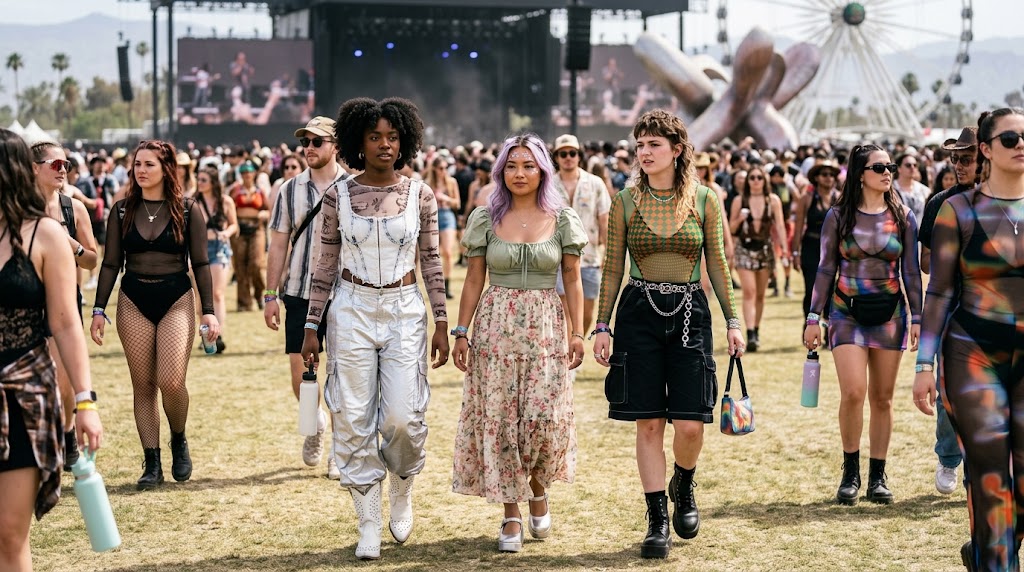
For over a decade, the global festival dress code was governed by a single, monolithic aesthetic. Commonly dubbed “Coachella-core,” this visual template was defined by bohemian flower crowns, fringe suede vests, glitter-dusted cheekbones, and fast-fashion festival capsules designed to be worn once and discarded. It was an aesthetic engineered for static double-taps on early Instagram feeds—visually uniform, corporate-sponsored, and largely disconnected from the physical realities of outdoor music events.
Today, that predictable uniformity has completely collapsed.
Across platforms like TikTok, Instagram, and Pinterest, festival fashion has decentralized into a fast-moving, mood-board-driven landscape where micro-aesthetics, subcultural nostalgia, and personal identity collide. The contemporary festival attendee is no longer pulling inspiration from glossy fashion magazines or pre-packaged retail displays; they are sourcing ideas directly from nightlife communities, digital creator feeds, subcultural music archives, and personal thrifting habits.
This evolution marks a broader shift in youth culture. As long hours, extreme weather, and rising costs force attendees to rethink how they consume clothing, the modern festival wardrobe has become more intentional, tactile, and expressive. The trends dominating social feeds right now prioritize visual contrast, movement, and subcultural authenticity—proving that on the modern festival ground, personal identity beats corporate polish every time.
The “Club Girl” and Nightlife Revival: The Return of Unpolished Energy
The fastest-growing aesthetic across social algorithms signals a major pivot away from traditional daytime bohemian styling toward late-night club culture. Termed “Club Girl” fashion or “Indie Sleaze 2.0,” this trend trades sun-drenched flower-child imagery for the messy, high-energy aesthetic of warehouse raves, after-hours clubs, and underground electronic venues.
Driven by a cultural craving for authenticity and the rise of raw, unpolished digital content, the Club Girl aesthetic deliberately rejects stiff, over-styled looks in favor of effortless, nightlife-inspired ensembles:
- The Core Silhouette: Oversized vintage graphic tees paired with micro skirts, triangle bikini tops layered under structural jackets, and vintage track tops paired with sheer bottoms.
- Visual Identifiers: Distressed leather, heavy eyelet hardware, silver metallic accents, and bug-eye statement sunglasses worn indoors or long after sunset.
- The Attitude: Emphasizing flash photography, smudged eyeliner, disheveled hair, and a carefree energy that mimics the spontaneity of late-night music culture.
Unlike legacy festival trends that required months of specialized shopping, Club Girl styling relies heavily on items young consumers already own or thrift.By styling athletic loungewear, worn-in band tees, and nightlife basics with high-impact accessories, attendees achieve an “off-duty” look that feels spontaneous, cool, and built for late-night dance floors.
Outlaw Western: The Edgy Reinvention of the Cowgirl
Western-inspired festival attire is not new, but its modern iteration has traded sweet prairie tropes for heavy hardware and dark, “outlaw” energy.Fueled by high-profile Western crossovers across mainstream pop, hip-hop, and country music, cowgirl aesthetics have evolved into one of the most dominant visual forces on festival grounds worldwide.
The current iteration—frequently cataloged on social feeds as “Edgy Western” or “Bandit Core”—blends traditional Americana elements with grunge and rave sensibilities:
| Traditional Western Styling | Modern “Outlaw” Festival Styling |
| Soft tan suede vests & floral prairie skirts | Heavy, distressed faux-leather shackets & micro-shorts |
| Classic brown cowboy boots | Pointed-toe buckled harness boots & platform western footwear |
| Delicate silver turquoise jewelry | Double-slung grommet belts, heavy chain harnesses & stacked hardware |
| Neutral gingham & traditional bandanas | Studded handkerchief tops, lace-up corsets & sheer mesh layering |
The practical appeal of Western wear explains its persistent popularity. Rigid denim, heavy suede textures, and sturdy knee-high leather boots offer built-in protection against sun, dust, and muddy terrain, allowing festival-goers to maintain a striking visual silhouette while navigating demanding physical environments.
Sheer Layers, Piratecore, and Textural Maximalism
As short-form video platforms continue to dictate fashion viral moments, clothing that moves, catches light, or features distinct physical texture has surged in popularity. Static fabrics are increasingly sidelined for garments that offer dynamic visual movement when captured on camera.
This movement-first philosophy has birthed several interconnected micro-trends that dominate summer feeds:
1. Ethereal Sheer Layering
Sheer mesh dusters, open-knit crochet dresses, and sheer lace maxi skirts have become primary layering tools.By wearing semi-translucent dusters or lace wraps over high-cut bodysuits, bloomers, or bikini sets, attendees create dimensional, romantic silhouettes without adding thermal weight during hot daytime sets.
2. “Piratecore” and Whimsical Roughness
Borrowing visual cues from historical costuming, nautical fantasy, and festival fairy aesthetics, “Piratecore” has emerged as a viral favorite. Characterized by flouncy off-the-shoulder blouses, distressed suede vests, tiered ruffle skirts, frilled bloomers, and lace-up corsetry, this trend balances rugged, weathered textures with soft, romantic drapery.
3. High-Gloss Metallic and Mermaid Textures
Drawing inspiration from dance floor subcultures, pearl-encrusted fishnets, sequin mini skirts, and liquid metallic tops provide high-contrast reflections under festival lighting rigs and natural sunlight.These light-reflecting elements ensure that outfits stand out in crowds and pop on digital video feeds.
The “Clean Base” Strategy: Accessories Doing the Heavy Lifting
Perhaps the most significant structural change in festival dressing is the widespread rejection of hyper-complex, single-use outfits in favor of the “clean base” styling strategy.
Faced with global economic pressures and a growing awareness of fast-fashion waste, younger consumers are increasingly building festival looks around simple, high-quality staple garments that can be worn in everyday life. The transformation from mundane streetwear to high-impact festival outfit relies entirely on aggressive, intentional accessory stacking.
Clean Base Garment (Neutral Tank Top + Vintage Denim Cutoffs)
                     ↓
[Stacked Accessory Layering: Double Belts + Body Chains + Statement Sunnies + Head Scarf]
                     ↓
High-Impact, Re-wearable Festival Look
Key accessories leading this trend include:
- Stacked Belts and Heavy Hardware:Layering a wide grommet leather belt over a slim chain belt or coin belt to cinch the waist and add visual weight.
- Vintage Head Scarves and Silk Wraps: Functioning simultaneously as sun protection, hair management in dusty winds, and a high-contrast style statement.
- Layered Jewelry Stacks:Mixing metals, chunky pendant necklaces, thick arm cuffs, and body chains over minimal tops to give basic items a custom, handcrafted feel.
- Retro and Futuristic Eyewear:From rimless 2000s tinted lenses to heavy metallic speed-wraps, statement sunglasses serve as the ultimate focal point for close-up social media posts.
This accessory-centric approach allows festival-goers to repack the same base denim or basic bodysuits across a multi-day event, completely changing their aesthetic each day simply by swapping their accessory stacks.
Functional Footwear and the Death of “Unwearable” Fits
For years, a persistent divide existed between festival fashion editorial spreads and the physical reality of walking 20,000 steps a day across uneven fields. Uncomfortable high heels, cheap plastic sandals, and restrictive, non-breathable synthetic garments often resulted in physical discomfort long before headlining acts took the stage.
In 2026, social feeds reflect a major cultural consensus: unwearable festival fashion is out, and functional durability is in.
The modern festival consumer evaluates footwear through a lens that balances practical performance with subcultural style:
- Chunky Utility and Combat Boots: Heavy-soled leather boots remain the undisputed footwear baseline, offering ankle support, foot protection in dense crowds, and effortless grunge styling.
- Distressed Western Boots: Elevated cowgirl boots provide a sleek, structured silhouette while remaining comfortable enough for full-day wear.
- Retro Technical Sneakers: Chunky 2000s running shoes and technical trail sneakers have crossed over into mainstream festival wardrobes, paired intentionally with romantic lace skirts or micro-shorts to create striking high-low visual contrast.
Simultaneously, hybrid garments like skorts (skirt-short hybrids) and tailored bloomers have replaced restrictive micro-minis, giving attendees total freedom of movement on dance floors and grass fields without sacrificing style.
The Shift Toward Re-Wearability and Archive Thrifting
Underpinning all of these visual trends is a fundamental shift in consumer mindset. The era of buying a cheap, synthetic outfit online that ends up in a landfill after a single weekend is giving way to a more conscious, archive-driven fashion philosophy.
Driven by environmental considerations and a desire for unique style that algorithms cannot easily replicate, young festival-goers are turning to vintage resale platforms, thrift archives, and DIY customization. Authentic vintage denim, broken-in leather jackets, pre-loved designer scarves, and upcycled graphic tees are prized precisely because they carry character, history, and physical durability.
Festival fashion is no longer about conforming to a brand’s idea of what a music fan should look like. It has become an exercise in creative curation—a space where subcultural nostalgia, practical engineering, and personal identity converge to create looks that look as good on a dusty dance floor as they do on a digital feed.


 admin
admin