
 Roland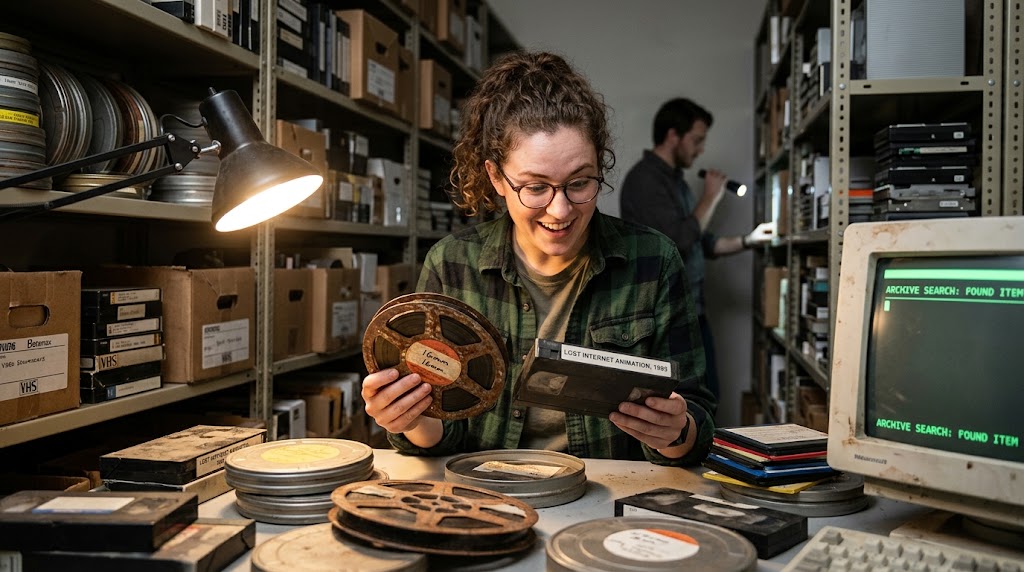
In mid-2008, deep in the subterranean archives of the Museo del Cine in Buenos Aires, archivists made a discovery that sent shockwaves through the global cinematic community. Tucked away in a forgotten box was an old 16mm film print of Fritz Lang’s 1927 masterpiece, Metropolis. For more than eight decades, roughly a quarter of Lang’s dystopian epic had been considered permanently lost to history, destroyed by cuts and studio neglect. The recovered footage restored missing storylines, contextualized character motives, and completed one of the foundational works of modern cinema.
Fast forward to the digital era, and a very different kind of search unfolds daily across internet message boards, Discord servers, and online archives. Thousands of sleuths, historians, and hobbyists spend years tracking down obscure fragments of human culture: a 1980s Japanese anime pilot never released on home video, an unedited version of a early-2000s web animation, a lost video game prototype, or a snippet of a mysterious pop song recorded off a West German radio station during the Cold War.
This is the world of lost media hunting. Once the exclusive domain of professional film archivists and institutional librarians, media preservation has transformed into a global, crowdsourced movement. Part digital archaeology, part collective detective work, the hunt for lost internet and film treasures highlights a sobering reality of modern culture: despite living in an era of unprecedented digital abundance, human creative history remains surprisingly fragile.
The Historical Roots: Nitrate, Wiping, and Studio Neglect
To understand why lost media exists today, one must look back to the early decades of mass entertainment, where long-term preservation was rarely viewed as a priority. In the silent film era, motion pictures were treated as ephemeral consumer goods, intended for brief theatrical runs before being discarded or recycled for their silver content.
Compounding the problem was the physical medium itself. Until the early 1950s, motion pictures were shot on cellulose nitrate film stock. Highly flammable and chemically unstable, nitrate film decomposes over time into a volatile jelly before turning into combustible dust. Studio fires—such as the catastrophic 1937 Fox film storage fire—wiped out thousands of original camera negatives in a matter of hours. The U.S. Library of Congress estimates that approximately 75 percent of all American silent feature films are lost forever, including original works by pioneering directors like F.W. Murnau and Oscar Micheaux.
As broadcasting evolved in the mid-20th century, television inherited a similar disregard for archival permanence. During the 1960s and 1970s, major networks across North America and Europe routinely practiced “wiping”—erasing magnetic master tapes so the expensive tape could be reused for subsequent broadcasts.
The British Broadcasting Corporation famously erased hundreds of hours of historical programming, including early performances by Peter Cook and Dudley Moore, classic news broadcasts, and over 90 original episodes of the iconic science fiction series Doctor Who. Were it not for overseas broadcast copies transferred to 16mm film and stored in international relay stations across Africa and the Caribbean, many of these cultural milestones would have vanished entirely.
The Digital Mirage: Why the Cloud Is Erasing History
A common misconception of the modern age is that the internet guarantees permanent preservation. In reality, digital media has proved to be just as fragile as nitrate film, albeit in fundamentally different ways. The phenomenon known as “bit rot”—the gradual corruption of digital data on physical drives—alongside link rot, platform shutdowns, and digital rights management (DRM), has created a silent crisis in media retention.
The early internet era, spanning the mid-1990s through the late 2000s, was a golden age of user-generated creativity. Websites like Newgrounds, GeoCities, early YouTube, and localized forums fostered vibrant subcultures of Flash animation, independent music, fan dubs, and interactive web games. However, when corporate platforms shuttered or shifted technical standards, decades of digital culture vanished overnight.
Key factors driving the rapid loss of digital media include:
- Platform Closures: The shutdown of historic hosting platforms, such as GeoCities in 2009 or Vine in 2017, resulted in the deletion of millions of unique audio, video, and text records that were never backed up elsewhere.
- Technology Deprecation: The end-of-life decision for Adobe Flash in December 2020 suddenly rendered thousands of interactive web games, artistic animations, and educational tools unplayable on modern browsers without specialized emulation.
- Digital Storefront Shutdowns: The closure of digital marketplaces, such as the Nintendo Wii U and 3DS eShops or early mobile app stores, has made hundreds of digital-only video games legally inaccessible and physically unretrievable for mainstream consumers.
- Corporate Delisting: In the modern streaming era, media conglomerates regularly delete original films and television series from subscription services for tax write-offs or to avoid paying ongoing licensing royalties, turning high-budget projects into modern lost media overnight.
As media transitions from physical media—such as DVDs, CDs, and print—to server-side cloud streams, consumers no longer own copies of the works they enjoy. When a distributor pulls a title from a platform, it vanishes instantly across the globe, leaving preservationists scrambling to secure unofficial rips before the content disappears forever.
Crowdsourced Sleuths: Inside the Internet’s Greatest Searches
Faced with this growing void, internet communities have built sophisticated crowdsourced networks to locate, verify, and digitize missing media. Platforms like the Lost Media Wiki, organized subreddits, and dedicated Discord servers bring together tens of thousands of volunteer researchers around the globe.
The process of finding lost media combines high-tech data scraping with classic investigative reporting. Hunters analyze old TV listings, review microfiche records, file Freedom of Information Act (FOIA) requests, inspect archived web pages on the Wayback Machine, and reach out directly to retired broadcast engineers, voice actors, and production assistants.
One of the most famous examples of internet-driven media preservation involved a mysterious track nicknamed “Ulterior Motives” (often referred to by fans as “Everyone Knows That”). Recorded off a European television broadcast in the late 1980s, a 17-second audio snippet was uploaded to an online forum in 2021. For three years, a global community of over 40,000 members analyzed drum machine models, accent inflections, and synthesizer patches. In 2024, researchers finally traced the audio track back to a obscure 1980s film soundtrack, leading to the discovery of the original master tape and the identification of its original creators.
Similar crowdsourced efforts have successfully uncovered long-lost broadcast pilots, such as the original 1990s English-language pilot for the Sailor Moon franchise, unreleased video game source codes, and lost news footage from historical events.
The Psychology of the Hunt: Nostalgia, Archaeology, and Curiosity
What drives thousands of individuals to spend hundreds of hours searching for a 30-second commercial bumper, a cancelled cartoon pitch, or a missing scene from an obscure horror film?
At its core, lost media hunting satisfies a deep human impulse for mystery solving and cultural preservation. Unlike traditional academic research, lost media searches are highly democratic; a 16-year-old with an interest in web scraping has just as much chance of cracking a cold case as a university archivist.
Nostalgia plays an undeniable role. Many searches begin with half-remembered childhood memories—a strange short film seen on public television late at night, or an eerie bumper aired between Saturday morning cartoons. When viewers attempt to find proof that these experiences existed, only to discover no record of them online, it creates a compelling psychological challenge. The search becomes a process of validating personal memory against historical record.
Furthermore, lost media offers a tangible sense of discovery in an age where almost all information feels instantaneous and pre-packaged. Finding a lost work of art offers the rare sensation of stepping into unexplored territory—rescuing something lost to the abyss of time and reintroducing it to the world.
The Legal and Ethical Battles of Digital Preservation
While lost media hunters view their work as a vital public service, the movement constantly operates in a complex legal landscape dominated by copyright law.
Under current international copyright frameworks, works created in the late 20th and early 21st centuries remain protected for decades, even if the copyright holder no longer sells, distributes, or archives the work. Organizations like the Internet Archive, the Video Game History Foundation, and private collectors frequently face legal resistance from corporate rightsholders when attempting to digitize and publicly mirror out-of-print or abandoned media.
Key legal and technical challenges facing preservationists include:
- Orphan Works: Millions of photos, films, software programs, and sound recordings belong to companies or individuals that no longer exist or cannot be identified. Under strict copyright law, archiving these works for public access remains legally risky, leaving the media in a state of administrative limbo.
- Anti-Circumvention Laws: Legislation such as the Digital Millennium Copyright Act (DMCA) prohibits bypassing digital locks or encryption, even when doing so is necessary to preserve a game or film stored on degrading media.
- Physical Decay: Magnetic tapes used in 1980s and 1990s television production suffer from “sticky-shed syndrome”—a chemical breakdown of the binder holding the magnetic material to the tape base. Without immediate, expensive thermal treatment and digitization, physical tapes around the world are deteriorating beyond recovery.
Preservation advocates argue that copyright laws must be modernized to grant cultural institutions and non-profit archivists clear exemptions to back up abandoned software, broadcast television, and out-of-print film elements before they degrade completely.
Restoring the Broken Chain of Cultural History
The hunt for lost media is fundamentally an effort to protect human memory. Every lost film reel, missing audio master, and abandoned piece of software represents a broken link in the cultural chain—a moment where creative expression was swallowed by time, corporate neglect, or technical obsolescence.
The growing popularity of lost media hunting demonstrates that audiences are unwilling to let corporate strategy or digital fragility dictate what parts of history survive. Through a combination of archival discipline, investigative tenacity, and global digital collaboration, these modern sleuths are ensuring that the artifacts of our shared culture—both high art and low-budget pop ephemera—remain available for future generations to study, evaluate, and enjoy.
Whether in a dusty basement archive in South America or an online forum spanning multiple continents, the search continues. So long as media continues to vanish, there will always be those dedicated to bringing it back into the light.